Brighton and Rottingdean Seashore Electric Railway
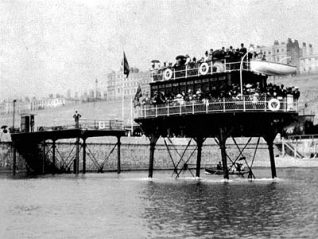
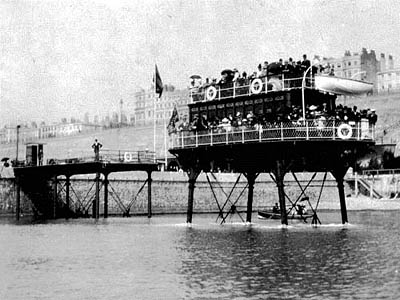
The Brighton and Rottingdean Seashore Elecric Railway, the so-called Daddy Longlegs railway, was built in 1896. This was a proposal by Magnus Volk for a railway that ran along on rails underneath the sea for about 50 to 100 yards offshore, from where his existing electric railway finished all the way to Rottingdean, where it was connected to a pier. The tramcar ran on stilts that were about 24 feet above the sea bed.
It was quite luxurious
The single car, called the Pioneer, was essentially an open deck, above which was an inside car which was quite luxurious and had leather upholstered seats. Above this was an outside deck with slatted seating, rather like you’ll find on a liner. The power lines then came down from above that.
Operated by a trained sea captain
Because it was travelling over the sea, the only way the Pioneer could obtain a licence was to have a trained sea captain actually operating it or being available at all times. He knew whether the sea was safe to travel over. The Pioneer had to have a lifeboat on the back and a number of lifebelts round the edges so that if there was a problem people would be able to get away. In effect, it was treated almost as though it was a ship.
Ceased operations in 1901
The railway was fairly short lived. It opened in 1896, but ceased to operate in 1901 when the council were introducing more sea defences along the coast and wanted to build groynes out into the sea. An agreement was reached whereby the track was removed and Magnus was given as compensation an addition to his existing land-based electric railway.


Comments about this page
I purchased a poster of the Daddy-Longlegs at an antique store that I think dates to 1896, and is on page 105 in the book ‘A History of Brighton and Hove’. Is this a rare poster to have?
Can you please tell me where Magnus Volk resided at the time of his death?
I don’t know exactly where Magnus Volk died but I will assume it was in Brighton as he is buried in the churchyard at St Wulfran’s Ovingdean. He lived from 1851-1937.
Answer to P.Holden’s question- Magnus Volk’s last address was 38 Dyke Road,the house was directly above the tunnel on the Brighton to Shoreham railway link. This road has now been renumbered.
I drive along the Coast Road from Hove to Newhaven and back every day to work. On the way back to Hove, if the tide is very low, as you drive down the hill from Rottingdean to the large round-a-bout by St Dunstans, if you look carefully you can see the impression of the old Daddy Longlegs track base. I have been meaning to get down onto the beach to examine it more carefully, but never seem to make the time. I suspect also that its one of those things that you can see from a distance, but not up close! I dont think that the remains are there, however you can see that the “Black Rock” sea bed has been distrubed, and the out-line of the track traces two dead straight lines running parallel to the shore. Their perspective disapears into the distance by the east side of Brighton Marina. Of course Brighton Marina must have been built right on top of one part of the old track! What would Magnus Volk think of the Marina?
Just to clarify — the ‘legs’ on the Daddy Longlegs did not actually move independently like the walkers in Star Wars, correct? If I am reading this correctly the legs were attached to a rail car that was underneath the water.
Regarding the construction of the Daddy Longlegs, the legs were fixed to the deck. I believe that at the base of each leg was a bogie of four wheels, i.e four bogies in total. Each bogie ran on one of the two rail tracks located on the sea bed. Current was collected from a pair of ‘trolley wires’ so presumably there were several support poles placed at regular intervals. Also I presume that the drive was by an electric motor down drive shafts to probably two or four of the bogies. I believe that the destruction of the Daddy Longlegs was a storm which severely damaged the track. I would not be surprised if the future was in doubt beforehand and the storm damage, plus the previously mentioned planned sea defences, which sealed its fate.
I was born in Brighton, now residing in Australia. Am contemplating building a 4mm operating scale model of the Volks Daddy Longlegs Railway. Have a couple of published items on the Volks Railway but the photographs contain therein all show the rail car from the seaward side. I’m after a good shot of the shore side of the car. Are there any general arrangement drawings available? Would love to be able to get the thing to work, even real use water to get the high tide effect.
Magnus Volk once lived in No 8 Arundel Street, I have a large collection of glass plate pictures of him. He was a friend of Mr Owens who took the pictures.
I have had an intrerest in this since I first saw it. Though living in Sydney Australia means I cannot even visit the remains. I have been considering building a working model – does anyone have any drawings at all of it – or pictures taken on board?
Does anyone know of any similar inventions in the UK like the the Daddy Long Legs that might still be in use?
Conrad Volk wrote a biography of his father which was published in 1971 by Phillimore & Co. Ltd. It has some pictures which clearly show the construction of the track bed, the bogies and the framework. One such picture is on the cover in fact. A worth while read if you can find a copy.
There is nothing like the Daddy Longlegs in use now anywhere that I know of, and there probably wasn’t at the time either! It was really a tramcar on tall rigid stilts that kept the passenger platform above the waves and ran on two parallel sets of rails for stability. The sets of rails ran on parallel concrete blocks and some of these can still be seen in certain conditions. Part of the two parallel trackways through the flat chalk seabed can be seen too. Yes, there would have been tall poles alongside the track carrying the copper wire that supplied the power. What did for the Daddy Longlegs was the extension of the sea defence groynes (the storm that destroyed the Chain Pier in December 1896 also cauased great damage but Magnus Volk had repaired this and restored operations by mid- 1897). Probably Magnus was not too worried – he received financial compensation when the line had to close and by then he must have known that the high maintenance costs and constant risk of storm damage made the Daddy Longlegs unviable. He had proved his point however that it could be done. Incidentally – part of the compensation was an agreement that he could extend the existing Volks Railway from Banjo Groyne to Black Rock: to do this he simply knocked out the back of the depot building where the line originally terminated and built the line through it, which is why (leaving Peter Pan’s for Black Rock) the line still seems to go out through the back of a shed.
I recently heard on the B.B.C. South local news that a model of the prototype of the Daddy Longlegs has been found, and is to be displayed in a local museum (sorry, can’t remember the details of the museum).
Magnus Volk died on 20 May 1937.
Will there be any celebration of his life as this year will 70 years since his death ?
My sister’s grave is next to his oldest son Magnus Hermann his wife Ella Annie and, maybe, their only child who was born and died early in 1913.
I’m Magnus Volk’s great grandson Bernard Volk, and in the nexts 9 years I will try to raise the money to re-build the daddy long legs. But at this time, I would love to hear from people if they think this is a good plan, so if you can e-mail me on berniepvolk@hotmail.com
In response to the enquiry about anything similar to the daddylonglegs. There is this, which is capable of reaching the island it serves when the tide is up, however it doesn’t run on rails.
http://www.bbc.co.uk/devon/content/image_galleries/burgh_island_gallery.shtml?10
We travelled back from Newhaven today and stopped to look at the tracks. By looking at old photo’s it seems that the metal track has gone but the stones the tracks were laid on are still there. It’s amazing to think they’re still there after all these years.
I think rebuilding the Daddy Long Legs would be a fantastic idea Bernard!
Hi everybody, I am an amateur local film maker and I made a film featuring views of the seabed and visible remains of this superb line last year. Taking advantage of the low tides and great weather in September 2006, I could get really clear shots of remaining sleepers and even timber telegraph poles still embedded in the seabed. For details of my website email me at dumpman1@hotmail.co.uk
I would love to see it run again but is that really a realistic proposition ?
I am chairman of the Volk’s Electric Railway Association. To clarify an earlier comment about the overhead wire. Although the car had two trolley poles, there was only one overhead wire. Return current was through the rails at low tide, and through the sea itself at high tide! Early photos of the car under test have recently come to light when the car was operating with one trolley pole. Presumably the second was added as a safety measure, as if one failed while the car was at sea there would be no way of getting it back home again. There was one other line that had some similarities to Daddy Long Legs, and that was the Pont Roulant, or rolling bridge, that ran across the harbour entrance at St Malo in France. It too ran on rails that were covered at high tide, but it was cable hauled and not self powered. It lasted from 1874 to 1923. It is assumed that a visit to St Malo gave Magnus Volk the inspiration to build the Rottingdean line.
Currently, the correct image on the bbc site can be found athttp://www.bbc.co.uk/devon/content/image_galleries/burgh_island_gallery.shtml?4 Yes, rebuilding would be a good plan. The original Daddy Long Legs was cool, so would be a new one. Incidentally, I searched for this railway after remembering a small picture in a book for kids I read in the seventies, so it obviously left a lasting impression on me.
Last night’s (14/7/2009) edition of the BBC TV programme ‘Coast’ featured the story of Daddy Longlegs including the only known film of the vehicle in operation. You can watch in on the BBC’s iPlayer for the next week. I had never heard of Daddy Longlegs prior to this show and found it fascinating.
This vehicle is more important than most people know as it represents one of the, if not the, earliest overhead line powered rail system in the world. It was powered by 500 Volts DC which was generated in the workshop on the top of the cliffs as shown in the BBC ‘Coast’ programme. Although electric powered by two motors mounted on the deck in diagonally opposite corners, the other corners had a braking system. All the power was transfered down the legs by shafts onto bevell geared axles in each of the pods at the base of the legs. The vehicle actually had a lifeboat which can be seen on the picture at the start of this site. The reason for the vehicle running over the sea was that the Victorians had a real health thing about ‘taking the sea air’, and this vehicle provided the most convienient way of doing this. There was a similar vehicle used across Liverpool bay but that was cable hauled. That vehicle also dates about the same period. I have done some research about electric railways and this is the earliest overhead line powered passenger railway I have been able to find. I would value a copy of the video taken of Daddy long legs, and I have a copy of the booklet ‘Volk’s Railways’ which contains many illustrations of this incredible vehicle. It is funny how such an important vehicle should be almost buried in history and yet be such a contraption that no one would attempt such a device in today’s world. Does this say something about the world of today’s engineering, or show the enterprise of a bygone age that approached madness?
Model makers – You may care to read this article on my 1/24 scale Pioneer on my Meccano model engineering website http://hisg.50webs.com/Pioneer_website/index.htm and are welcome to browse it, and even contact me for more information using the info at the bottom of the page. For the record, I am still the only person ever to have made it with or from Meccano, since it started in 1901 by Frank Hornby as ‘Mechanics made easy‘ – The name Meccano was adopted in 1907.
Kevin: I wish I had seen that film too. Hope it will appear on YouTube in future.
Mike: Top!
The film of Daddy Long Legs was made in 1897 by George Albert Smith. Unfortunately we can’t make copies of it or distribute it at the moment because, unbelievably, it is still in copyright! Smith died at the grand old age of 95 in 1959, and copyright lasts 70 years after the death of a film’s creator. Until we can trace Smith’s descendants and get their permission to make copies of the film, you’ll have to be content with watching the episode of “Coast” which is still available on BBC iPlayer. The one you want is series 4, episode 1, Whitstable to Isle of Wight. To clarify Graham’s comments on the use of overhead wire. The first successful system to use overhead wire with trolley poles was the tram (or streetcar, if you prefer) system of Richmond, Virginia in 1885 when the trolley pole was invented by Frank Sprague, an American electrical pioneer who was their equivalent of Magnus Volk. Overhead wires with trolley poles were first used in the UK on trams at Roundhay Park in Leeds in 1891. The Manx Electric Railway in the Isle of Man opened in 1893 with overhead wires, but they used a rigid bow type of collector at first, going over to trolley poles in 1898. The generating equipment for the line was installed in a compartment under the pier at Rottingdean. The generator on the seafront in Brighton was for the original Volk’s Electric Railway. Ian Gledhill, Volk’s Electric Railway Association
I’m doing a project on the Daddy Long Legs. It’s really interesting and I’d love to see it re-built.
Sadly, I can’t post a link in here but anyone with an interest in producing or seeing a model of this device might like to look here: http://modelengineeringwebsite.co/Volks_Electric_Railway.html
The link to the models should be: http://modelengineeringwebsite.com/Volks_Electric_Railway.html
A model of Pioneer may be found in Brighton Museum. Recent inquiries at the Museum have elicited the reply that they have no record of this. Volk’s original model was shown on a BBC Coast programme. But I remember a far grander and more detailed model being exhibited at the Museum in the 1960s. Does anyone know where the larger more detailed model now is?
Here is a short You Tube movie clip of the Daddy Longlegs in action: http://www.youtube.com/watch?v=ZlL8g29lEkg&feature=autoplay&list=PL570283055302AEA1&lf=results_main&playnext=2
Add a comment about this page