Principal street for food shops in the 18th century


Please note that this text is an extract from a reference work written in 1990. As a result, some of the content may not reflect recent research, changes and events.
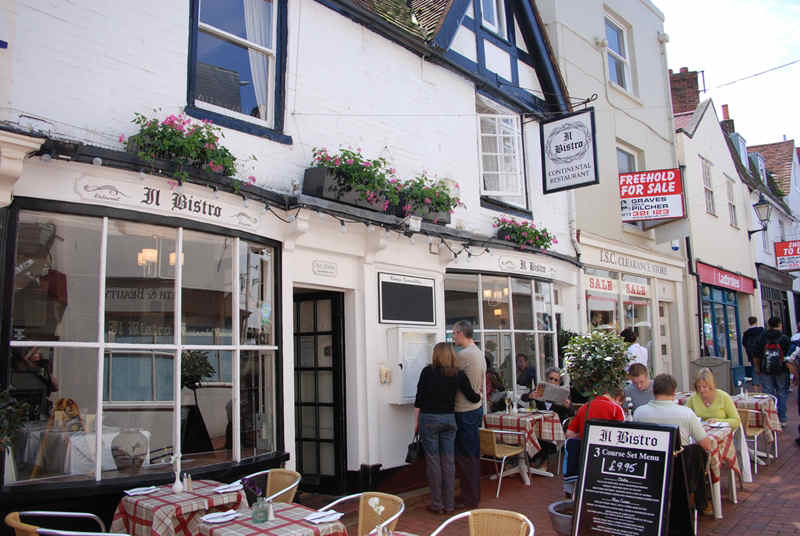
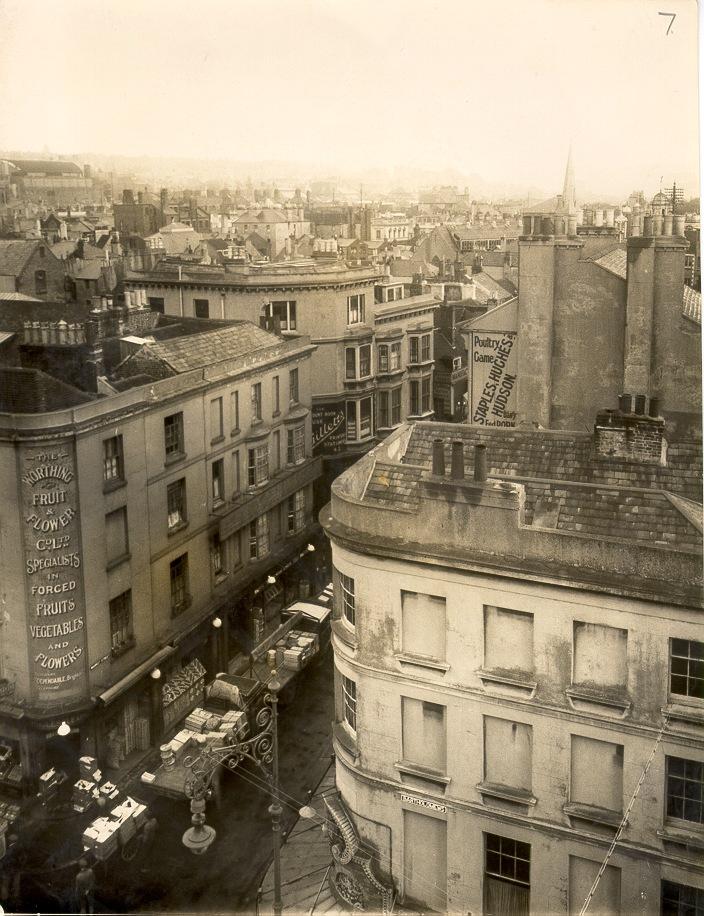
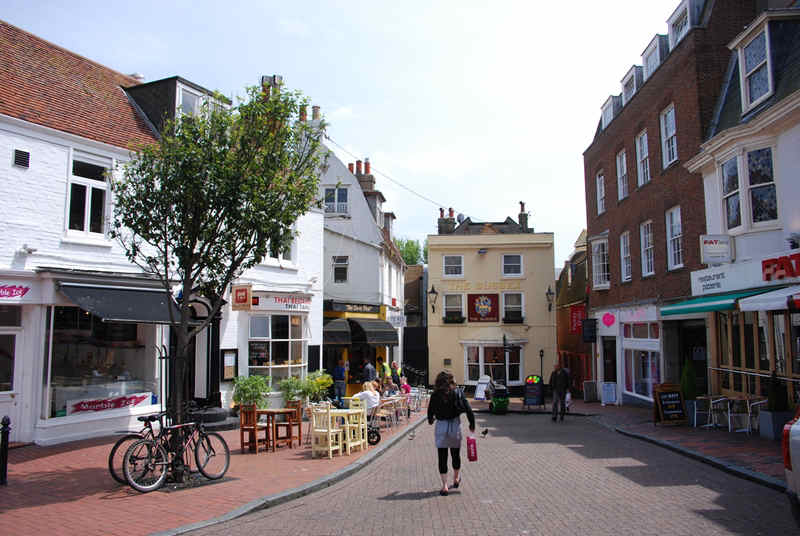
m) MARKET STREET : This street is named from the market that was held on the Bartholomews in front of the old Town Hall from about 1730, but the northern part, once known as Golden Lion Lane, was partially developed around the seventeenth century with further growth in the latter eighteenth century; building in the southern part was stimulated by the presence of the market, and was further encouraged by the new market hall that opened in 1774. Market Street then came to be the principal street for food shops, particularly meat and dairy produce. In 1984 though, the southern half was completely obliterated by the construction of Bartholomew Square and the Hospitality Inn, but the northern part of Market Street , together with Brighton Place and Nile Street , was pedestrianised in February 1989 (formally inaugurated April 1989). {10,14}
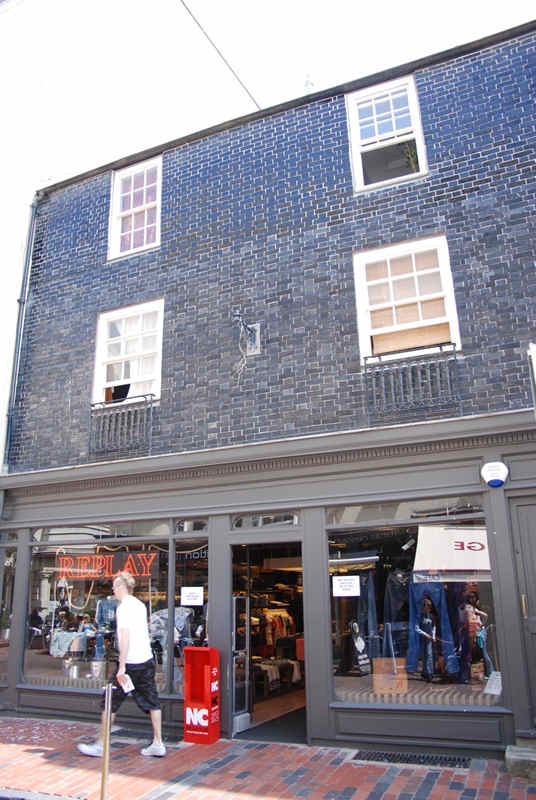
That part to the north of Brighton Place, the former Golden Lion Lane, is lined with late-eighteenth- and early-nineteenth-century buildings. The Market Inn changed its name from the Golden Fleece in 1990. A four-storey, listed, brick building with two first-floor bow windows, it was once known as the Three Chimneys because the owner was the Prince of Wales’s chimney-sweep. Nos.3-7 are faced with mathematical tiles , and the eighteenth-century nos.48-48a are also listed. The bridge over the street linking two buildings of the Hanningtons store was constructed in 1989. {15,44}
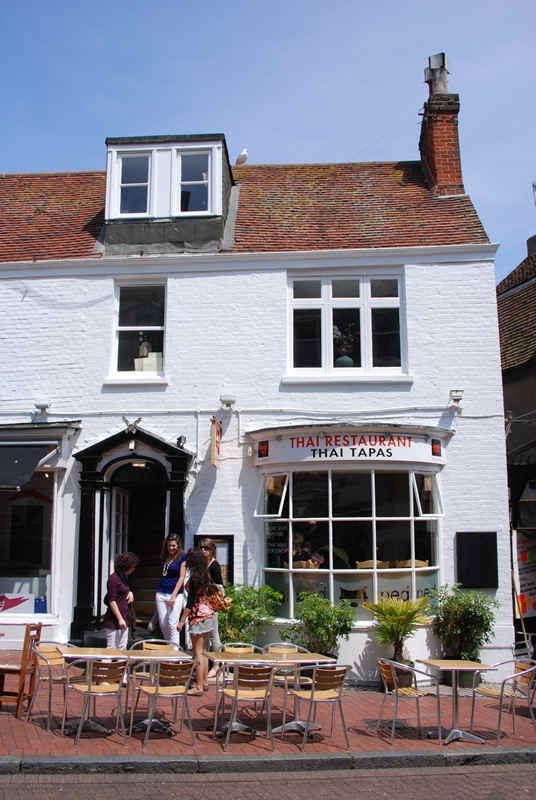
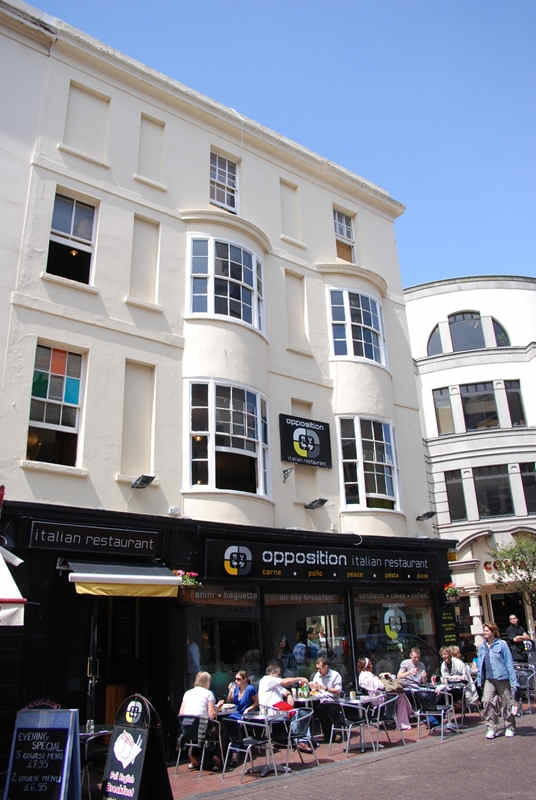
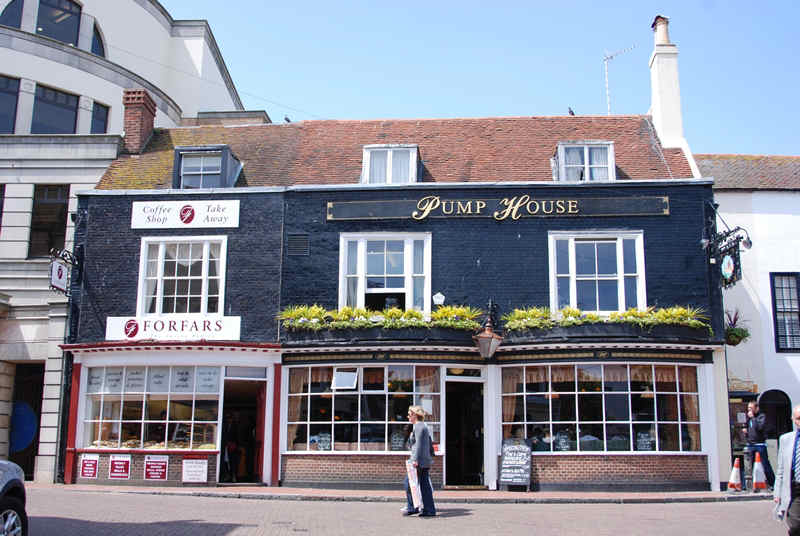
At the junction with Brighton Place, Market Street widens out to form one of the most attractive parts of Brighton, and is lined with late-eighteenth- and early-nineteenth-century listed buildings. No.11 has a bow window and is faced with mathematical tiles with flint on the eastern side. The mid-nineteenth-century no.47, unusual in red and grey chequered brick, is also listed. The Sussex Tavern faces both Market Street and East Street , and was said to be the haunt of smugglers; it was known as the Spread Eagle until 1816. The Pump House , nos.44-46, dates from at least 1776 and possibly from much earlier. Probably named from the town well that once stood nearby on the Knab, the present facade of black mathematical tiles and bow windows dates from the early nineteenth century. Adjacent are the shops and offices of the Nile Pavilions, designed in a mixture of classical and Art Deco styles by the Robin Clayton Partnership and erected in 1987-9. {44,123}
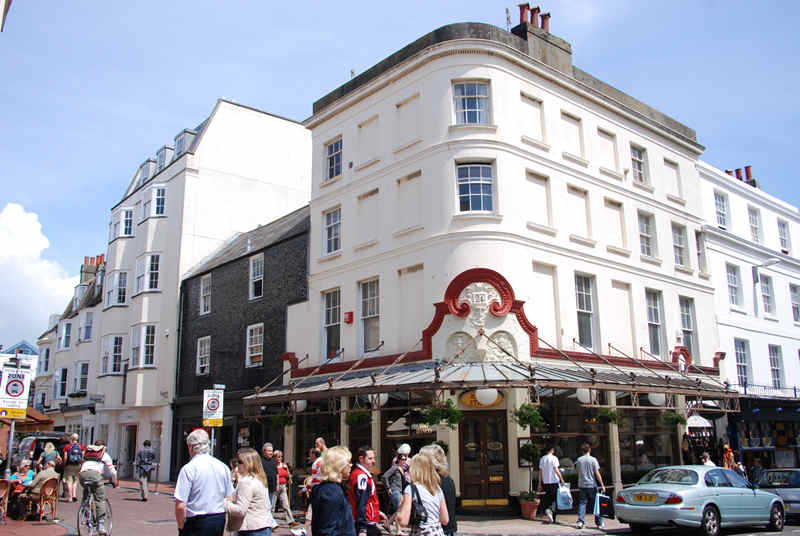
To the south of Brighton Place, nos.18-22 Market Street are a row of rather plain buildings, but no.23 is faced in black mathematical tiles and is listed. No.24 is rather ugly, but has a good ironwork and glass canopy over the pavement and elaborate decoration above the door. On the western side, no.41 is a four-storey, early-nineteenth-century, listed building with bows and glazing bars. {44}
Any numerical cross-references in the text above refer to resources in the Sources and Bibliography section of the Encyclopaedia of Brighton by Tim Carder.
Original page updated with photos and links 30/08/07


Comments about this page
My grandad, Charles Gravett, was a partner in a firm of wholesale greengrocers in this street up until his death in 1926. The firm was called Gravett, Roberts & Levett. Their horses and drays were stabled up by the ‘creech’ between Edward St and (I think) Sussex St up the hill from John St.
My great grandfather, Samuel Gravett Phillips, was born in 11 Market St. His father was John Gravett Phillips. I am currently researching my family history and would appreciate any further info on this area
My GGGgrandfather and his son, both named George Lower, were bakers and in the 1860s were bakers at 48/49 Market Street.
I lived at 41a Market Street, the four storey building with bows, in the late 1950s. My parents had a ‘beauty shop/hairdresser’ business there – my father, Louis C. Barry, proprietor. We were told that during WWII the building was used to house Canadian soldiers.
I grew up in Nile Street, leading into Market Street, in the 1950s and 1960s. The southern end of Market Street always had a bombed-out appearance with the remains of the market used as a car park and some small crumbling WW2 concrete buildings in a weed-strewn wasteland, until the whole area between Black Lion Street and Market Street south of the Town Hall was swept away in the disasterous 1984 redevelopment.
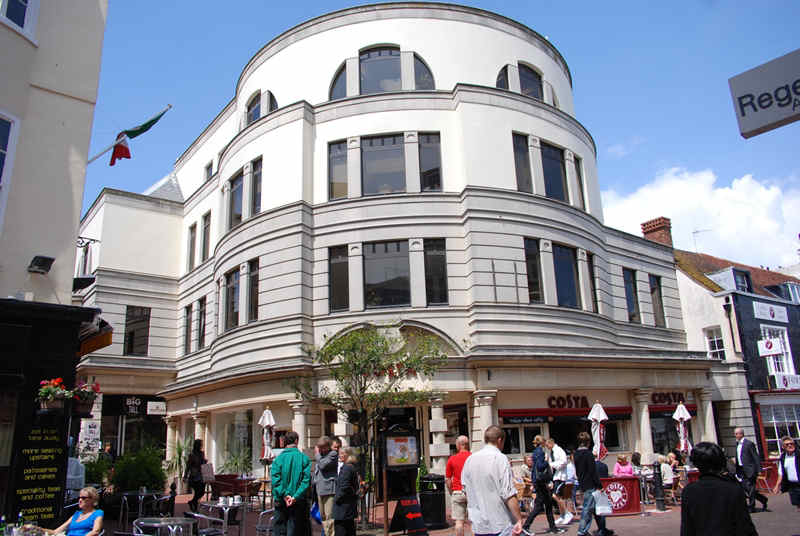
Roughly where Nile Street joined Market Street, on the opposite side of the road from Nile Street (eastern side of Market Street) was a cheap cider bar that in the early 60s often had the odd late evening punch up. Next door to the south was the Nanking Chinese Restaurant, a towering building that has now been gutted and turned into an up-market shopping arcade but in 1947 or 1948 was apparently the first Chinese restaurant in Brighton. I remember three generations of Chinese working (and possibly living) there and private Chinese New Year parties (regular patrons invited) where your drink would be topped up with whatever bottle was to hand.
Incongruously, next to the Nanking, on the corner, was the SPCK Christian Bookshop. Since the Teds, Mods and Rockers often drank or fought in the cider bar and ate afterwards at the Nanking (sometimes running up Nile Street to avoid paying but pursued by cleaver-waving Chinese cooks). I wonder if either of these places ever exchanged customers with the SPCK?
My great-grandfather is listed in Kelly’s as being a jewellery manufacturer at 23 Market Street. His name was Spyridion Marketis born 1842 in Zante, Greece.
My mum Joan (nee Andrew) was very young when she lived in the flat over what was the fishmongers in Market
Street, now The Deli. Unfortunately she doesn’t have fond memories of living there because of her mother Molly.
She lived there around 1945.
Thanks very much for the lovely photo of 24 Market Street. My Great Aunt Mabel Legendre (nee Philips), ran a tea room at this spot, sometime around 1928. Several of her sisters and a brother emigrated to Canada in the early 1900s, including my own grandmother, Lily Atkins (nee Philips) who emigrated in 1907. Two sisters stayed in Brighton, Mabel and her sister Maud.
My Great Grandfather lived at 33 Market Street in the middle 1800s and was employed as a servant.
My g g grandfather and his son, both named George Lower were bakers at 48/49 Market Street in the 1860s.
I understand that my Great Aunt, Violet Carter, was the landlady at this pub when it was ‘The Golden Fleece’ and that she and her husband, Nick, kept other pubs in Brighton. Does anybody remember them?
I am researching my wife’s family tree (Nicola Morton-Smith) and was delighted to find this page, even more so when I read the comment by Vic Phillips (23/04/2005) about his GGGgrandfather having the bakery at 49 in 1860. The census for 1841 and 1851 shows that my wife’s GGGgrandfather, Harry Slaughter, was the baker before Vic’s. Perhaps someone could let him know just out of interest. Is number 49 still standing by the way? Thanks, and again, extremely good site.
My grandfather and grandmother ran the Pump House till the early fifties. Fishermen walked up from the beach after landing their catch and into the pub-seaboots,oilskins and fish scales included. I was aquainted with the pub from pram time till early fifties when my grandfather died and my gran gave the pub up to Forfars. When the Nanking Chinese restaurant opened, the first manager [Mr Mann] lodged in the pub with them. The oak panels in the bar were upstairs painted dark green till Forfars cleaned them up and moved them downstairs. When the panels were dismantled from the walls, the fireplace which is also downstairs was found behind them. My grandparents names were Sidney and May Ramsey. Regards
I’ve added a photo under the title ‘G W Lower’ to the site which shows my nana outside. I am also a descendant of the Lower’s.
When I delivered milk to The Golden Fleece, the landlord’s name was George. A Burma Railway veteran, he held the respect of all who met him. There were joking remarks made referring to George and the Dragon, (his wife, whom he obviously idolized). Sandra was the name of the daughter. Lovely family.
I’m doing some research into the Titcomb family, and I believe that no. 48 Market Street was an antique shop run by E.M. and L.M. Titcomb, which specialised in toys and dolls houses in the 1950s.
Hi Jennifer, it was not until around 1958 that Titcomb’s took over the premises at 48, Market Street, probably moving there after previously having a shop at 42, King’s Road. The business was only there for a short time, closing its doors around 1963. Regards, Andy
Does anyone remember around 1971, a film showing Gilbert O’ Sullivan riding a bike down Market Street to the soundtrack of ‘Matrimony?’ It was when it was a proper road and he rode down towards East Street. I can’t seem to find it on Youtube and I’m sure it was in black & white.
Thank you for the details. As a young child I visited Brighton and was taken to the Chinese restaurant by a lady who had been a missionary in China. Knowing name and location of restaurant adds to memories – visit was around 1950.
Hi, The Nanking resturant, 21-22 Market Street, was opened by my Grandfather, Mr. Chong Kai Yan. He came to England in 1925 by simply deciding to walk off the ship he was on, he was a Chinese merchant seaman, when the ship was at the docks in Liverpool. During the Second World War he ran a Chinese restaurant in London. He survived a bomb blast by being late one day, and missing his usual bus which was hit by a bomb. He remembered all the American GIs that were over in England back then, they were great tippers. After the war was over he went back to China to find my Grandma and my Dad. He was also a brain cancer survivor. The surgeon back in the 50s remarked that he was “a lucky devil”. Had he been in China, he would probably have not survived. Back then England had the best medical care in the world. Eventually he settled in Brighton and opened the Nanking, and Chungking Chinese restaurants. Back then Chinese restaurants were priced at the cheap end of the market, the “McDonalds” of the day. The restaurant was also run by my Dad, with Mum helping out on Fridays and Saturday nights, the busiest days of the week. Eventually the American fast food restaurant invasion took over and the restaurant was sold. The ground floor was cleared and paved as an open entry way to the shopping arcade although the upper floors remained. Our family is still in the hospitality business. My brother owns and runs a hotel in Umbria, Italy, near the town of Montone. The hotel’s name is Moravola.
I’ve just discovered my ancestors lived at 21, Market Street. Robert Hughes and his family lived there for quite a while. Robert was a poulter by trade with his wife, Francis, nee Gibbs. Robert died at his residence 1871, aged 78 years. His Father, Robert, was a butcher. I’m still doing a lot of research on the area, but my location makes it hard since I’m in Australia.
I’m trying to find any information about a William (Bill) Irvin or Irvine or Irving who was landlord of the Golden Fleece but don’t know dates. He was born in 1908.
The date of Bill Irvine (?) was probably around 1949
This is where we lived in the 1950’s, before I moved up to London at age 16 and then to the U.S. in 1958.
Add a comment about this page