The final days
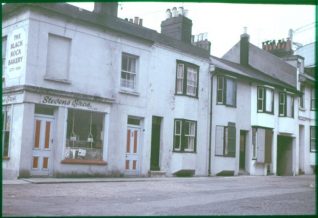
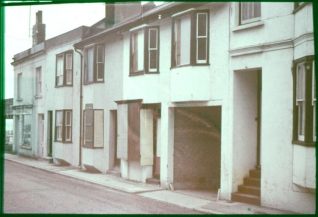
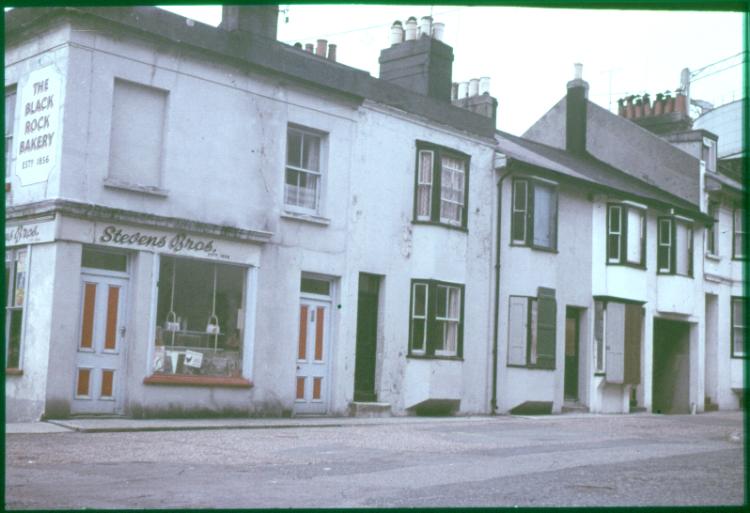
Rifle Butt Road is one of the ‘lost streets’ of Brighton. Built in the late 1860s, it was removed in the 1970s to make way for the approach road to the Marina. Within living memory it was part of a lively community at Black Rock. In its length of no more than 200 yards it included a bakery and other shops, a Quaker burial ground, a builders yard, a gas works and housing. In the days before the National Health Service there had also been a branch of the Brighton, Hove and Preston Provident Dispensary, providing low-cost health care. The bakery pre-dated the road: its painted sign says it was established in 1856.
By the time these photos were taken in September 1971 the street’s days were clearly numbered and it has the forlorn look of a place awaiting the developers. The bakery is still there on the corner but other shops and houses were already boarded up. The gas holder on the corner with Roedean Road can be seen over the rooftops.



Comments about this page
I would be very interested to know of any photographs or information about the ‘Black Rock Ironworks’ (in Rifle Butt Lane), that closed down in about the 60s. It was started in 1887. Many pieces of ironwork have been made, namely Roedean Gates, the Public Library gates and some at the Royal Pavilion. It was run by my great grandfather and his father before him (William Saunders Jnr/Snr) who were both church wardens at the Chapel Royal in Brighton. Any information on my relatives or the iron foundry would be greatly appreciated.
As a child I often wondered what the unfinished structure was at the bottom of Rifle Butt Road. It was no more than a few concrete pillars, a building project that was never finished. After all these years can someone enlighten me? I often wondered as a child when the builders would return, they never did.
I too remember those concrete columns with the reinforcing sticking out. I lived just round the corner in Arundel St and my son went to school and used to play with the Stevens boy from the bakery.
Today I was at the Brighton Museum and was very suprised from looking at an old map that Marine Gate where I live used to be an old burial ground for the Quakers and was the place for the meeting house. The remains were dug up and moved to Woodingdean in 1974.
Between 1947 and 1957 I lived at 1 Arundel Street which backed on to the old concrete pillar site. It was our cat’s favourite hunting ground and provided an ideal launch-site for my unsuccessful model rockets, one of which landed right in front of a rapidly decelerating Southdown bus on the coast road! I was told that it was the proposed site of a bakery, abandoned because of the war. One of my old mates was Michael Viney, Tony Viney’s brother. I have just again made contact with Michael after 50 years. (Hi Tony). Lots of good memories of living at Black Rock: sea and lido just across the road, excellent bus links to most of Brighton and Hove, etc. Just a bit miffed that they’ve plonked the Marina right on top of my favourite prawning grounds. The biggest ones were always under Mr Volk’s spider railway concrete support blocks!
I was a classmate of the the twin sons of the builder in Rifle Butt Road, John and Peter King. We went to St Luke’s Terrace Junior School until 1949. I don’t know what happened to the twins after taking the 11 plus in that year, as I went off to the the Building School. My aunt and cousin lived in the end house opposite the King’s builders’ yard, their name was Stevens, (no relation or link to the bakers shop at No 1).
I lived at 4 Hillside Cottages (’44-’68), just north of the graveyard, but still only 100 yards from the super baker, Stevens. Sad that the Marina buried some popular ‘undercliff’ beaches. Tramps used to sleep in the unfinished concrete structure. Campers from East Brighton Park used to steal our milk off the doorstep en route to the beach!
With regard to the comments about the structure at the bottom of Rifle Butt Road by Terry Anderson 07/11/2004: I too always wondered what they were. After going to Saturday morning pictures at the Odeon Kemp Town, we would walk along the seafront and spend a bit of time in some disused shelters and then make our way up to Rifle Butt Road and play in that derelict building. I remember at the back of the basement there was a staircase which led up to the top. My parents lived in Rifle Butt Road and my sister was born there. The family then moved to Whitehawk Avenue where I was born. I also remember Mr Stevens’ bakery and went to school with his daughter, Marion, at Whitehawk Secondary School. My grandfather lived at 4 Black Rock Cottages with his mother and stepfather. His half-brother lived with his grandparents at 2 Hillside Cottages. My father also worked at the Brighton Hove and Worthing Gas Company until the outbreak of WWII.
As a child I lived in Sadler Way. Rifle Butt Road was on my direct route to Black Rock Pool or the beach. I mostly remember us all believing that the cemetery was haunted. We always made haste as we passed it. I also remember the petrol station at the top end somewhere, and receiving an enormous balloon as a gift for my dad filling up our Ford Anglia. It was nearly as big as the car!
Researching about my past and found this website. My grandparents ran Stevens Brothers bakery. I have great memories of the place as I spent most of my school holidays there.
I moved to Cliffe Road, around the corner from Rifle Butt Lane in about 1962 and the Ironworks was gone by then. I do have a memory of a small bakery in Rifle Butt Road that sold the most delicious 1d rolls to a hungry 14 year old.
Was Peter Guy any relation to the hairdresser Mr. Guy who had a barber’s shop in Whitehawk Road in the 50s? When we were kids he always had a line that he cut his hair with a knife and fork.
I’m very pleased to have found this site as my Father and Aunt grew up in Rifle Butt Road and they always spoke fondly of those years. One memory always brought a special smile to my Dad’s face, and that was the smell of the bakery! I wonder if anyone knew them? The Vines and the Kennards.
I was driving along the coast road this afternoon with my wife (who used to live in Whitehawk years ago) and she mentioned Rifle Butt Road as we passed, and I wonder where the name Rifle Butt Road came from?
My parents lived in Rifle Butt Road between 1947 and 1949, in the terraced cottage closest to the gasometer. I was a small baby, 18 months old when they moved away to Hollingbury. But I remember my mother telling me that the cottage was damp because the wall near the gasometer had been cracked by a near miss from a wartime bomb. My father had a story about his uncle saying, “So you live in Rifle Butt Road now, that’s good because we can go for a drink in the Abergavenny Arms” – and my father then told him that the cliff had slipped and the pub gone into the sea years before. By the way, the name Rifle Butt Road is because from the 1870s, it was the site of a rifle range laid out for volunteer soldiers, (Encyclopaedia of Brighton, Timothy Carder, East Sussex County Libraries, ISBN 086 147 3159)
My grandmother was brought up at the bakery in Rifle Butt Road. Their family name was Souch. She used to deliver bread with her father on his horse and cart across the area. She told me of how they would make a small charge to cook the Sunday lunch for local residents using the baking ovens of the bakery. She was born about 1890s I think and knew of Kings shop. Her father was Charles Stephen Webster Souch and her mother was Edith. They also had a son Tom who remained in the Brighton area. Nan told me that Rudyard Kipling was a customer at the bakery. Her uncle was a photograher in Brighton and she said he contributed to a book called Breezy Brighton Photos, though I have never been able to find any evidence of it.
My father was the local Taxi in Arundel Street, Madeira mansions, backing on to boundary Road; of course no longer there as this made way for the flats called Coursels. As a young lad I spent a lot of time in and around Rifle Butt Road, I used to pick up my mum’s bread from Stevens the Bakers and pick off the crust on the way home. I am still in touch with Pat Stevens.
We moved to Wilson Avenue in January 1961, and I remember Rifle Butt Road, it comprised of the gasworks on one side and a row of cottages on the other, plus a graveyard, and there was a bakers at the bottom, and I think their surname was Stevens/Stephens as their son was in the same class as me at Whitehawk Seniors. I used to walk down Rifle Butt Road on my way to night fish the beaches at Black Rock, next to the bakers was a derelict concrete building that eventually became a garage, as I used to use the bus stop outside that garage on occasions.
We lived in Rifle Butt Road until they knocked it down; we lived at number 5. My mum used to send us to Stephens bakery with a pilllow case to buy day old bread for 6d to make bread pudding with. We were the last family to move out, we lived in the upstairs flat, Laura Humphreys and her family lived downstairs, her sons were Barry, John & Peter.
My name is Vic Lander. My father’s family lived in Rifle Butt Road from the mid 1800s. The Vines, Kennards, Morleys and Souchs were all related to the Landers. My father was born in No 13 Rifle Butt Road in 1893. On marrying my mother they also lived at No 13, my brother Percy John Lander, (recently deceased) was also born there in 1923. When demolition took place in the 1930s to make way for Marine Gate, No 13 was the house were the demolition began. My family was re-housed in Whitehawk. I was born in 1940 when we lived at 42 Whitehawk Road. In 1942 the King family, who were family friends, offered us a house in Rifle Butt Road next to the meeting hall. In 1943 the house was made unhabitable by bombing and we were once again re-housed in Whitehawk. Bert and Kit Stevens were my god-parents and I grew up with their daughters Marion and Janet. Tom Souch was the publican at “The Northumberland Arms” in St Georges Road, now a dental surgery I believe. He left there in the 1960s and moved to Arundel Street. The concrete structure that seems to have created some mystery was to have been a showrooms and distrbution centre for the Gas Board. Work was halted on the outbreak of WW2 and never recommenced. Vagrants used to sleep in the structure and buy stale bread from the bakery.
Well, I remember Victor Lander! Uncle Percy’s brother! All those years ago. I learned about Percy’s sad passing in the Argus and left a message there. My Dad was George (known as Ken) Kennard, son of Nellie (nee Vine) and George Valentine Kennard and brother to Gladys. Nellie and George were married at St Margarets Church in Rottingdean in October 1911. My Dad was born in 1922, a year before Percy. After the RAF he worked for Nicholls Garage in North Street opposite the old swimming baths. How the area has changed! How Brighton has changed.
Back to Nellie Vine: she was rehoused during the demolition and went to live in Whitehawk Road, Gladys later moved to Bates Estate in the 50’s with her lovely husband Tom Green. Ken and his wife Doreen moved to Arundel Terrace and later went to Bates Estate when it was newly built. I remember Aunt Dora and Carol; lovely people. I wish you all well.
Hi Lynda
Great to make contact after all these years. I remember you very well. During the war because your Grandmother and Gladys were rather nervous they would spend the nights at our house in Fletching Road and if the air-raid sirens went off your Gran was first into the Morrison shelter. I now live in Lancing but I am Vice Chairman of the East Brighton Local History Society, we meet on the second Wednesday of each month at the Valley Social Centre in Whitehawk Way. Our meetings commence at 2pm, why not visit us where you will meet many old “Whitehawkers” who will remember our family.
Love and best wishes your cousin Vic.
Vic, I’ll give you an email contact: cotswoldromany@yahoo.co.uk
How nice it was to find this website and read the comments from people who lived there and knew my parents Bert & Kit. I remember several of the people who posted their comments very well. We moved to Cambridge in 1960 and later on to the Caribbean, we used to visit from Cambridge regularly on school holidays to stay with my parents.
Hi Marian. Many years no see. I thought you might see my name above and remember the happy childhood days we spent together. Remember the teas your mum used to lay on with me having to sit in the high chair even when I was ten or twelve years old. This was because Janet said that as I was the youngest it was only right that I had the chair. Remember when your mum used to go into hospital and you and Janet stayed with us in Whitehawk. Happy, happy days. Contact me.
Hello Vic, nice to hear from you. Yes it’s been a long, long time. Our e-mail is spidaweb@talktalk.net we look forward to hearing from you.
A truly wonderful site, long may it reign. Does anyone remember the Freeman family? My Father has just passed away in January, aged 98. He was the local Taxi driver. Mick Pierson if you read this, please contact me. My email address is as follows: Glassman1@sky.com. Cheers and beers Tony Freeman.
I found this site whilst reserching my family history. My grandad ran the (Stevens Bakery). I’m Ian Stevens, my dad is Roy Stevens and my grandad was Ken Stevens also known as the ‘The Midnight Baker’. Would anyone have any more pictures of the bakery and anyone connected with it? I see Marian Webber has made some comments about the bakery and Rifle Butt Road and I think my nan and grandad (Ken and Elsie) were your aunty and uncle. You can contact me on IANSTEVENS817@BTINTERNET.COM
This has been very interesting reading. Many thanks.
Ian Stevens: we have tried to contact you via email, have you received our mail? Our email address is posted a few comments up on this page.
In 1871 my G, G, Grandfather was the range keeper for the Rifle range in Sheepcote Valley which is, I think where the race track is. He and his family lived in Rifle Butts Cottage, I dont know if this was in rifle Butts Road but the census does not show many other properties there at that date.
I lived in Rifle Butt Road, cemetary opposite, Black Rock swimming pool etc. I can still remember the smell of Stevens bakery, and bread baking, my name is Gwen Walls, fun days there.
In the late 50s, when I was little, Dad and Mum would book a caravan for a weeks holiday at Sheepcote Valley. It was such an adventure for my brother and me. We would walk up and down Rifle Butt Road when going to the beach and I particularly remember a wonderful sweet shop. I still visit that area a lot, but prefer my memories of the place.
What a fantastic find. My Dad and Mum kept The Whitehawk Inn. I remember Mr and Mrs Freeman, always so smartly dressed, Stevens bakery where our birthday cakes were made and the Grant family who also lived in Rifle Butt Rd. Happy days
Wow – what a fab site. Am quite weepy reading all the memories of Stevens bakery, my grandparents lived there, Grandad baked with his brothers Ken and Ern while Nan ran the shop. Ian – your dad Roy taught me (and my brother Francis) to drive, he used to pick me up from Cardinal Newman School then we’d end up at home. Now living in Yorkshire, still miss the bakery when we visit – the Marina is not the same!
I have just been reading the above messages and found one from Bob Pickett dated July ’07. He queried the origins of the name Rifle Butt Road. I can only think of one reason, that the road has one broad end and a narrower northern section; the broad end being the butt and the narrow end being the barrel. I was at the Building School in the early fifties and we had our games, mainly rugby, in East Brighton Park so I occasionally used the road.
I have happy memories of Stevens Bakery. From 1962 to 1966, as a schoolboy, I worked part-time for them. Each Saturday I begin work early morning helping Ken and Ernie unload the oven and stack the bread into the two delivery vans. Would then spend the rest of the day with Ernie delivering the bread to customers throughout Whitehawk and Woodingdean. I also worked with Ernie several evenings a week after school and during most school holidays. Stevens Bakery was very much a family affair. Ernie’s son Derek also assisted on the delivery rounds as did Ken’s son Roy. I have fond memories of Nan who ran the shop. I recall she was especially keen and vocal when watching Saturday afternoon wrestling on television. Each evening when I started work Nan would supply me with a bag of cakes for my tea. Fifty years on – when I smell freshly baked bread it brings back happy memories of the bakery and the good members of the Stevens family.
Great reading all theses comments and learning more history about my family’s bakery. I am Karen Stevens, Ken and Elsie’s grand daughter, Roy’s daughter and Ian’s sister. Unfortunately and very sadly my grandad passed away the year before I was born so I never had the chance to meet him but have heard so much about him and the bakery and would love to learn more and see more photographs and find any other family I don’t know about! Many thanks
I have just come across this page whilst searching for Rifle Butt Lane Rottingdean. My husband’s grandmother grew up at no 2 Black Rock Cottages, Rifle Butt Lane. Her name was Queenie Rushman if anyone has any memories?
Hi Jacqui, My wife’s aunt was Queenie Rushman. We too are looking into the family history and the places they lived. You can contact us at; c_saunders@tiscali.co.uk
Hi all, my grand parents, Harry and Gertrude Briggs lived at 8 Hillside Cottages. Could anbody please tell me where Hillside Cottages were in Rifle Butt Road? ie at the bottom on the East side or the West side?
Hi, this message is for Paul Briggs. Unfortunately, having had a break from this site for quite some time, I’ve only just seen your post of March 2017. However, if you would like to contact me on technocrat637@gmail.com I can forward you a copy of a drawing I did showing the layout of Rifle Butt Road in the early 1800s including Hillside Cottages. My interest stems from the fact that several of my family had properties in both Rifle Butt Road & Black Rock Cottages in the 1800s through to the mid 1900s.
My father is John King, one of the twins mentioned above and the son of the builders GJ King. I stumbled upon this site looking for old photos. It is my dad’s 80th birthday this year. After they left Rifle Butt Road, they moved to Wilson Avenue and my dad and uncle went to Hove College. My dad, and uncle, his twin brother, Peter continued the family business moving it to St George’s Road in Kemp Town and then on to a site in Sayers Common that is still owned by the family today. They built the business up to be a major regional contractor and they were well known in the 80s for restoring the Royal Pavilion. Sadly, my uncle died in 2004, aged 65. I never met my grandfather, George King as he died before I was born, but my grandmother Winnifred lived until she was 103 having married a composer in 1972. My mum and dad still live in Hove today.
My Father Ernest Albert Bristow was born in Rifle Butt Cottage in 1902. Are there any photographs of the cottage?
Alison woolgar I wonder if you can shed some light on something.
My great grand parents Reg and daisy King live at 2 rifle butt road during the WW1 where Reg died age 32 in 1918.
I always assumed the builders yard was something to do with him and having read about the twins thought they must be related.do you have any information about this?
Thanks
Andy
My great great grand parents Henry and Lottie King lived at 38 Quebec street.
A bit more history. According to the 1911 census, my maternal great grandfather Alfred Simpson and wife Alice and four children Joan, Dorothy, Stanley and Herbert lived at 11 Rifle Butt Rd. Joan was the youngest (born 1907 in Ealing), so I guess they were only there for a short time. Alfred and Alice were relocated to 94 Whitehawk Rd, and I remember visiting them there in early 1960s.
Hello Paul Briggs, I lived at 4 Hillside Cottages from 1944 – 69. The cottages were just north of the graveyard on the East side of the road facing the gasworks. They were numbered from No.1 going north, so No.8 would have been just before the ‘alley’ in which the blacksmiths was located. The firestation was built partly on our back gardens. I still only buy artisan bread, after growing up near Stevens ! ( I now live in Havant ).
My Uncles Tommy & Robert with their dog Galie lived in Riffle Butt Road. I have several pictures of them and family stood outside. Theirs was to the right of no.9 (So perhaps 8,7 or 10,11?)
Hi Andy Panayi. I don’t think they were related and have done some ancestry research.
Sadly my father, John King passed away last year after a short battle with terminal cancer cause by asbestos exposure on building sites.
Add a comment about this page