What's in a name?
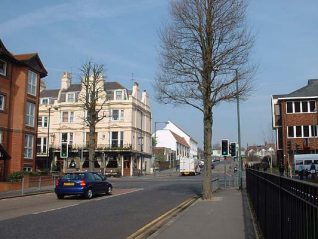
Several street names of the area of Hove surrounding St Ann’s Well Gardens tell the story of an industrious and remarkable immigrant family whose members successfully campaigned in the Victorian age for legislation which lifted the restrictions on Jews, Catholics and other non-Anglicans, enabling them to enter government, the professions and higher education for the first time.
Sir Isaac Lyon Goldmid (1778-1859) was the grandson of Aaron Goldsmid, a Jewish merchant from Amsterdam who settled in this country with his family in 1763. Sir Isaac was a banker and financier who kept company with the leading intellectuals and statesmen of his day, and was a very progressive thinker. He was a founding member of the group that established UniversityCollege, London, purchasing the site with his own funds. He was a pioneer of the Reform Synagogue in England, this work being continued by his son Sir Francis Goldsmid, MP (1808-1878), who also supported many of his father’s other causes.
When Sir Isaac completed his purchase of the Wick Estate in 1830, much of it was still open countryside. A property known as The Wick, which once stood just to the south of the modern park, became his seaside retreat. As Sir Isaac and his successors developed the surrounding area, they sought to record aspects of Anglo-Jewish history, together with the achievements of family members, in the names of the new roads that they built.
Cromwell Road
This is the western continuation of Davigdor Road. Its name records a significant moment of history. In 1290 all Jews were expelled from this country. They were unable to return until Oliver Cromwell gave his permission in 1656.
Goldsmid Road
This road was one of the first to be built and bears the family name. Conveyances of the properties there are dated 1843 – long before most of the neighbouring developments took place, and therefore completed during the lifetime of Sir Isaac Goldsmid. Extends westward from the Seven Dials and originally included a section of what is now Davigdor Road.
Palmeira Square/Palmeira Avenue /Palmeira Mews
To the north of Adelaide Crescent. In 1846 Sir Isaac was awarded the title Baron de Goldsmid e da Palmeira by the government of Portugal after his timely intervention sorted out the terrible financial muddle which had arisen when Brazil was granted independence. Goldsmid never used the title of Baron, preferring simply to call himself Sir Isaac, which was his right as a result of the baronetcy conferred upon him by Queen Victoria in 1841 . However, one of his great grandchildren chose to revive it, calling herself Violet Baroness de Goldsmid e da Palmeira (1869-1949).
Holland Road
From Kingsway all the way up to Lyndhurst Road. Commemorates Lord Holland, a close friend of Sir Isaac who made great efforts to support his campaign for Jewish emancipation. He put in a request to Lord Melbourne for the title of Baronet to be conferred on Sir Isaac.
Lansdowne Road/Lansdowne Place/Lansdowne Street
Lansdowne Road runs from east to west just to the south of the gardens. Lansdowne Place and Lansdowne Street connect to the south side of Lansdowne Road. Named after the Marquis of Lansdowne who was prominent among the Liberal peers who supported Sir Isaac in his efforts over many years for the removal of the civil disabilities of Jews and other groups.
Somerhill Road/Somerhill Avenue
These roads lie on the western boundary of St Ann’s Well gardens. Somerhill was a large country house and estate near Tonbridge in Kent which was purchased by Sir Isaac in 1849. It became home for at least two generations of his descendents.
Nizells Avenue/Nizells Lane
Nizells Avenue forms the northern boundary of St Ann’s Well Gardens. Nizells Lane is a pedestrian way between Nizells Avenue and Davigdor Road. Nizells was another large house near Tonbridge bought by the Goldsmids.
Davigdor Road
This is the continuation of Goldsmid Road through to Cromwell Road. In 1840 Sir Isaac’s daughter Rachel married a French Jewish aristocrat, Count Solomon Henri d’Avigdor. As with all of Sir Isaac Goldsmid’s daughters who married, the name Goldsmid had to be incorporated into the family name as a condition of inheritance. The children of Rachel and Solomon were known as d’Avigdor-Goldsmid. This line of the family was responsible for much of the later house-building development within the area of the Wick Estate.
Julian Road
Runs between Addison Road and Davigdor Road. Named after Sir Julian Goldsmid (1838-1896), whose father was Sir Isaac’s youngest son, Frederick. He succeeded to the family estates (including Wick) when his uncle Francis died in 1878. Like both his father and uncle, he was an MP, serving for thirty years and becoming Deputy Speaker. He was also a Director of the London, Brighton and South Coast Railway. An engine was named Goldsmid after him in 1892.
Osmond Road/Osmond Gardens
Runs between Addison Road and the top of Nizells Avenue. Sir Osmond Elim d’Avigdor Goldsmid (1877-1940) was the grandson of Count Solomon d’Avigdor and Rachel d’Avigdor-Goldsmid. On the death of Sir Julian Goldsmid he succeeded to the family estates, including Somerhill in Kent, where he became very dedicated to that county, being appointed both Deputy Lieutenant and High Sheriff. Retired from service in the Great War with the rank of Lieutenant Colonel. Sir Osmond controlled the County Land and House Company which developed the area of the Wick Estate between Davigdor Road and Old Shoreham Road for housing, 1897-1910.
Montefiore Road
Between Old Shoreham Road and Davigdor Road passing over the main westbound railway line. In 1850 Emma Goldsmid, the youngest daughter of Sir Isaac, married Dr Nathaniel Mayer Montefiore (1819-1883). The family inheritance passed to their younger son, Claude Goldsmid Montefiore (1858-1938), when his brother Leonard died in 1879. Claude was a renowned biblical scholar, respected by both Jew and Christian alike. A man of great learning and social good works, he was effectively the originator of the Liberal Jewish Synagogue, feeling that Reform Judaism had not gone far enough in its journey from Orthodoxy. He was able to freely pursue, and give financial support to these interests on account of considerable family wealth from both sides. Legal records show that Claude Montefiore had a direct involvement in the management of the Wick Estate at the time that Montefiore Road was built.
Lyndhurst Road
Runs between Montefiore Road and the top of Holland Road on the north side of the railway line. This road is part of the development originally called the Lyndhurst Estate. Commemorates Lord Chancellor Lyndhurst, who successfully guided Sir Isaac Lyon Goldsmid’s Jewish Disabilities Removal Act through the House of Lords in 1845. Unusually among Goldsmid’s supporters he was a Tory.
Addison Road, Colbourne Road, Granville Road, Melville Road
These appear to be named after either local councillors or Liberal peers who assisted Sir Isaac in his successful efforts to introduce new legislation.
Lyon Close
This is a recent adoption, leading from Davigdor Road into the trading estate which lies between Holland Road and Montefiore Road on the south side of the railway line.
Harks back to Sir Isaac Lyon Goldsmid, although the name did reappear among his later descendants.
Note from the Editor:
I have tried to make the above history as accurate as possible from a wide range of records. I am happy to be corrected on any of it, and would also welcome your comments.
Pat Benham


Comments about this page
This was interesting as I am researching about Captain Ronald Francis Sherlock who, in the 1901 census, is aged 5 and living in Wick Lodge. Ronald was the grandson of the 8th Bt Lord Cockburn. Ronald was killed in action at the Somme in 1916.
A most interesting page. It would be good to have more pages about the origins of the city’s place names. Just one minor comment: Goldsmid was Sir Isaac by virtue of the baronetcy, ‘Sir’ being the title given to baronets.
Hello. My name is James Colbourne from Atlanta, Georgia in the United States. My great, great grandfather, James Colbourne, was the Mayor of Brighton in 1905. I have been told by my great aunt, his granddaughter, that Colbourne Road was named after this man. I believe he was also a Justice of the Peace and an Alderman while he lived in Brighton. Hope this helps.
Helpful comments. Just what is needed. I will let the text stand as it is for the moment. Thanks David, the point about the baronetcy is taken and, yes, James, your observation about the origin of the Colborne Road name must be right. Very interesting your connection there. Many thanks.
Very interesting article. Osmond d’Avigdor Goldsmid’s wife was called Alice Landau – I believe that Alice Street (between Holland Road and Lansdowne Place) was named after her.
Re the origins of Colbourne Road’s name: Might James Colbourne’s great-great-grandfather have given his name to Colbourne Avenue in Brighton? More likely I would have thought, as he had been Mayor of Brighton.
A fascinating website! I was particularly interested in the Colbourne link as I am researching my family and am also the great granddaughter of James Colbourne who I was told was Mayor of Brighton. I would be fascinated to find out whether this is the same ‘James’. My great grandfather was born in Kensington in 1852 and was married at least three times – my grandmother was his youngest daughter. She was born in Hove in 1905, she married Ronald Hudson, Brighton & Hove Town Planner in the war years, and had two children – my father was born in 1934 – and then I too was born in Hove, in 1965. I would love to contact James Colbourne in Atlanta, Georgia, to try and match histories – would you give me your email address?
Joanna Pettit. If no contact with James established yet, send an email to this website for advice.
I am currently writing a book about the small village of Blackford near Wincanton in Somerset and I have come across an entry in the 1891 census for Rachel Colbourne (unmarried aged 24) and her son James aged 7 living at East Hall Farm with John Martin Richards and his wife Jessica, who we believe was also a Colbourne. It would be very interesting to know what the circumstances of this James Colbourne’s birth were, since it seems he and his mother were both born in Kensington (as was Jessie). There is a legend within the owners of East Hall Farm that at a date in the 20th century a clome (bread oven) was opened up and inside there was a perfectly preserved ham which had been there from the time of a cancelled wedding some time in the 1880s. Could this be the clue to the birth of a child out of wedlock?
Thank you for explaining the origin of Hove street names. I’m writing a book about Mansfield College, a Jewish girls boarding school. It was in Cromwell Road from the early twentieth century, until the late 1950s, with a WW2 hiatus in North Wales. More information on the school would be very welcome.
Does anyone have any recollection of Davigdor Dairies?
I want to know if this was a childen’s home or convent called St Anne’s with sisters that worked there? I was put in the childen’s home when I was about 3 o4 4 and I am 63 now so it was some years ago. My name is Nina Alberici.
Nina. Please look at the page ‘Welcome to St Ann’s Well’ for this.
Re Mansfield College. There is information in The Jewish Chronicle. It began in 1894 in Maida Vale. In 1905 it opened a ‘branch’ in Cliftonville, and the first reference in the newspaper to Brighton was in January 1918. The last references to it in Brighton are in the summer of 1958.
I wonder if anyone can help. Some family history has just come to light regarding a relative of mine called Sister Maurus Tobin who was at St.Anne’s Convent in Hove in 1959. Does anyone remember her?
To SA Cooper: do you remember anyone called Nina Alberici? I was in the convent at about your time. Please get back to me on this. Thank you.
I remember Davigdor Dairies very well. They were on the south side of Cromwell Road or it’s extension, Davigdor Road, between Holland Road and St. Anne’s Well Road (I think it was called). I lived before the war in Wilbury Crescent and then in Cromwell Road, where my mother and aunt had a school, Mansfield College. After the war I lived in Wilbury Crescent and frequently walked, bused, or cycled past the dairies where you could see the bottles on the conveyor belt being filled. I don’t remember when they closed as I moved away in 1958. There was also a lovely dairy called Frowd’s in Church Road on a corner opposite Hill’s (?) department store.
Around 1955/56 a few of us from the Grammar School in Dyke Road went on a visit to Holes and Davigdor Dairy. We were shown how all the processing and bottling was done. One thing I do remember was being told that it was in that location because there was a natural water source available. John, I think the street name you are not sure of is Somerhill Road.
Does anyone remember my grandparents Edward (Teddy) and Doris Robinson who lived at Beagleford (29?)Cromwell Road? It was a quest house then -they had a whippet called jinx and Teddy was a taxi owner/driver. I remember the dairy although I was very young.
I have a photo of my father with other staff members at Holes and Davigdor dairy, taken before WWII, would you like me to upload a copy of it?
Editor’s note: Either upload the photo with as much info as you have about the time and the people (there is a link to a tutorial on how to do that here) – or send it to me via email: jennifer@mybrightonandhove.org.uk
My father, Fred Virgo, worked at Holes & Davigdor Dairies for many years, before becoming caretaker at Davigdor School. My first visit to this site – fascinating to read all those familiar names.
I remember your Dad, Marion, as your brother Terry was at the grammar school with me. I was also in the Riverside Jazz Band which used to practice in Davigdor School on Sunday mornings. We even successfully played a jazz club evening there with an small entrance fee. This may have been around 1957.
Sorry for the late reply to your comment, Pat. I will mention you to Terry – I’m sure he will remember you. Marion J.
I have just stumbled on the page about St Ann’s Well gardens – my local park when I was a mere lad. And the resulting references to Holes and Davigdor Dairies. I lived on the Dairy – literally since my father was the resident maintenance engineer. So I have many memories of the Dairy, from a boy’s perspective. Also Davigdor School next door but one which was also my playground Marion with your brother Terry.
I have come back to this page several years later – thank you Pat Benham for the offer to help me get in touch with James Colbourne from Atlanta (2006 /2007)- we managed to make contact and found we are in fact related. In case Susan Hartnell-Beavis returns to this page – the Jessie Richards she mentions (22 July 2007) was indeed a Colbourne and sister to James Colbourne, Mayor of Brighton and the subject of our previous comments. Rachel Colbourne who was visiting Jessie in Blackford during the 1891 census, is named as the head of household’s sister-in-law [Jessie’s sister], and the 7-year-old James also visiting at the time is named as the head of household’s nephew. However, this does not make Rachel Colbourne this young James’s unmarried mother – in fact he is the son of James ‘the Mayor’ Colbourne, and hence the nephew of both Rachel and Jessie. Hope this clears up any confusion, Susan!
Pleased to help, Joanna.
I worked in the office at the depot in Caledonion Road and some of the other offices when I first left school. I married a one of the milkman named Ron Berry.
I, too, have just come back to this page and am really grateful to Joanna Pettit for clearing the confusion over Rachel Colbourne and James. It just shows how easy it is to put 2 and 2 together and make five or even six, sometimes. I guess it was the intriguing story of the ham in the bread oven which fired my imagination!
Does anyone know why there is confusion over the spelling of St. Ann’s? It is Ann, rather than Anne? And why so named? Thoughts?
Add a comment about this page