History of number 53
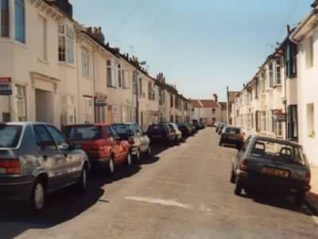
Speculation in the farmland that is now Hanover Ward began in the 1850s, although it was the mid 1860s before any building began. Toronto Terrace was a strip in the 5th furlong in Hilly Laine, which was subdivided. All deeds referred to it as number 45 in the Terrier (survey) made by Thomas Budgen in the seventeenth century. By the tithe survey of 1851 it had become plot 198e. The 12 pauls (approximately 6 acres) it contained had formerly belonged to Benjamin Masters, Sarah Boyes and Israel Paines, but eventually passed to the eccentric MP Thomas Reid Kemp, the man responsible for the development of Kemptown.
Piecemeal development
In the 1850s, it changed hands four times, until on 13th June 1863, it passed into the hands of Robert French, a gentleman, GD Sawyer, a timber merchant, James Bayley, a builder and Robert Adams, also a builder. It was this sort of loose financial partnership that made for much of the development of Brighton, with capital coming in from gentlemen, and builders eventually purchasing it from them with the profits from their small speculations. There is no record of who decided upon the layout of Toronto Terrace, but the building pattern below shows the piecemeal way the development was undertaken, with long gaps occurring before the fabric of the street was completed:
Date of approval Present number of house Developer
11/10/1864 14 – 17 Robert Adams
18/10/1864 31 (House & laundry) Mr. Hoather
?/12/1864 19 (Carpenter’s shop) Unknown
31/10/1866 10 William Parsons
16/01/1867 1 – 3 Mr. Hoather
22/08/1867 31 (addition to laundry) L. Holman
05/05/1869 19 (stable) W. Parsons
21/07/1869 65 – 67 W. Parsons
05/10/1869 62 – 64 W. Parsons
Autumn 1869 32 – 33 W. Cole
05/10/1870 43 W. Parsons
01/03/1870 44 – 61 W. Parsons
02/08/1870 34 – 42 W. Parsons
02/04/1879 68 – 72 & 64 Albion Hill J.R. Lidbetter
27/11/1891 63 (Shed) J. Lintott
William Parsons the builder
The builder responsible for the majority of building in Toronto Terrace, including number 53, was William Parsons. He was in business in 1867 as a carpenter at 69 Southover Street. By 1871, he was living at 60 Southover Street and assisted by his two oldest sons, 19-year-old Alfred and 16-year-old Richard. The speed with which his activities in Toronto Terrace progressed seems to have brought him prosperity, for by 1878 he was a builder living in a larger house in Sutherland Road, and in the 1880s moved to the distinctly middle class Dyke Road where he worked as a builder and contractor.
Designs of the houses
Despite the number of builders employed in the building of Toronto Terrace, the houses have an apparent uniformity, which seems to suggest the direct oversight of the original speculators, and the careful control exercised by the Brighton Corporation over house plans. It would seem that the houses were designed from a pattern in a standardised building book, frequently used by Victorian builders. The main part of each house was 17′ 6″ wide and 21′-23′ deep, with a small back wing. The ground floor contained a ‘parlour’, living room, a small kitchen and a small entrance hall leading to the stairs. There were two main bedrooms on the first floor and a rather small third one. Each house had a back garden with an outside WC with mains drainage and running water. The front door opened directly on to the street. The houses were built of brick rendered with stucco at the front and had slate roofs; the parlour had a small bay jutting out into the street. The houses, as with all other dwellings were subject to a ‘schedule of restrictive covenants’, which limited what activities could be carried out in the property. In the case of 53 Toronto Terrace, there were restrictions on the sale of beer, wine and spirits and the owners were not allowed to build stable carriage houses upon the land!
Who lived there?
When originally built Toronto Terrace had a young working class population, particularly married people with very young children. Comparing the inhabitants with those in neighbouring streets, those in Toronto Terrace seem to hold ‘superior’ stations of employment, with people engaged in the building and furniture trades as well as a number of tradesmen. The strength of Toronto Terrace lay in its number of laundry workers. There were two main laundries on the street, but the majority of laundry workers seem to have been female members of a family taking in washing to help cover the cost of the superior accommodation. This is born out by records showing that number 53 Toronto Terrace was originally a family home, but also described as a laundry.
The population of the area
The majority of Toronto Terrace’s population (60%) came from Brighton, with a further 18.8% coming from the rest Sussex. The remainder came from the rest of the country. The population of the street appears to have been very mobile, particularly in the pre-Second World War period. A reason for this could be that the rent for Toronto Terrace, as compared to similar dwellings in Brighton, was more than 60% higher. (8s per week as opposed to 5s.)
Working class families
The evidence of who lived at 53 Toronto Terrace shows similar findings to the rest of the street: the property was inhabited by working class families with young children. It is interesting to note the number of people living in the house; the living conditions must have been severely cramped when you consider that now most houses in Toronto Terrace have one or two people living in them, and very few households have any children.
First recorded inhabitant
The first recorded inhabitant of number 53 Toronto Terrace was in 1875 when a Mr. H.Y. Smith lived there, running a shop from the house. This was a particular surprise to find that the property had been used as a retail outlet. On further checking, I discovered that the house became a shop just a couple of years after it was built, until 1927, when the records indicate that it became entirely a private residence. During this period, the house was a shop downstairs, and the family lived upstairs in the three bedrooms. Following is a list of inhabitants:
Year Name Age Occupation Place of birth Source
1875 Smith, H.Y. General shopkeeper Pages Directory 1875
1881 Clarke, Charles 32 Cabdriver Brighton 1881 census
” Clarke, Harriet (wife) 31 Grocer Brighton “
” Clarke, Charles J. (son) 10 Schoolboy Brighton “
” Clarke, Harriet (daughter) 9 Schoolgirl Brighton “
” Clarke, Florence (daughter) 7 Schoolgirl Brighton “
” Clarke, Elaine 6 Schoolgirl Brighton “
” Clarke, John E. 38 Cabinet maker Stepney, Middlesex “
1887 Newman, Mrs Fanny Shopkeeper Kellys Directory of Sussex 1887
1888 Beminster, Mr Robert Grocer Pages Directory 1888
1890 Morris, Mrs General shopkeeper Pikes Brighton Directory 1890
1891 Neville, Charles 32 Porter Brighton 1891 census
” Neville, Marie (wife) 32 Grocer Brighton “
” Neville, Phillip (son) 4 – Brighton “
” Neville, Amy (daughter) 3 – Brighton “
” Neville, Mirium (daughter) 2 – Brighton “
” Thomas, J. (father-in-law) 67 Tailor Hailsham “
1895 Luck, Mrs E. Shopkeeper Kellys Directory of Sussex 1895
1901 Morris, Vivienne (widow) 47 Grocer/shopkeeper Brighton 1901 census
” Morris, Edith (daughter) 25 Teacher of music Brighton “
1909 Edwards, Arthur Shopkeeper Kellys Directory of Sussex 1909
1915 Realff, Mrs Lilly Shopkeeper Kellys Directory of Sussex 1915
1920 Russell, Frederick J. Furniture dealer Kellys Directory of Sussex 1920
1930 Cooper, Frank (owner) Electoral register 1930
” Cooper, Emily (wife) “
” Cager, Edith “
1936 Wilkins, Peter (owner) Electoral register 1936
” Wilkins, Ivy May (wife) “
” Humphry, William R. “
1940 Casey, Thomas Kellys Brighton Directory
1951 Casey, Thomas Electoral register 1951
” Casey, Kathleen A. “
1969 Martin, Gary J. Electoral register 1969
1970 Curruthers, Brian Electoral register 1970
” Martin, Gary J. “
1973 Batchelor, Michael A. Electoral register 1973
” Batchelor, Cheryl D. “
1975 Worrell, Brian Electoral register 1975
” Worrell, Toni “
1981 Davion, Anne M. Electoral register 1981
1982 Cadman, Alfred C. Electoral register 1982
” Davion, Anne M. “
1983 Byrne, P.J. Electoral register 1983
1987 Broughton, Martin A. Electoral register 1987
” Broughton, Sandra “
1994 Brett, Nicklaus Phillipe Electoral register 1994
” McLeod, Catriona S. “
1997 Carpenter, Michael P. Electoral register 1997
” Maddocks, Martin P. “
This list of residents shows how the composition of the households has changed over the past 130 years. The house started off with large families and towards the present it becomes much smaller units. It appears that number 53 became a furniture dealers’ in the 1920s, as it was still registered as a shop, but unlike the previous 50 years, Kellys Directory describes the occupant, Mr Frederick Russell as a furniture dealer. This was the last commercial venture to be undertaken at the house. I found it interesting to note that according to the 1901 census Mrs Vivienne Morris lived at the property, running the shop downstairs, while her daughter Edith Morris taught piano lessons upstairs. It appears that the early occupants of the house were out and out capitalists!
Patterns of occupation
I also found it interesting that the house had changed hands so frequently, I had assumed that houses in the latter part of the 19th century and early 20th would be occupied by one family for many years, changing hands as it was passed from parents to children. Perhaps this was not the case for 53 Toronto Terrace as it operated as a commercial premises, changing hands as shopkeepers moved on, or as families grew in the extremely cramped conditions.
Respectable artisans
Once established and completed Toronto Terrace became firmly fixed as a street for ‘respectable artisans’, whose comfort and prosperity increased considerably in the late Victorian period and early 20th century. During the Second World War, Hanover suffered from several bombing raids, with houses in Carlton Hill and Albion Hill being destroyed, and 104 people losing their lives. After the War, these bomb-damaged areas were redeveloped, with modern flats and small houses being built. The rest of Hanover however, including Toronto Terrace became rundown with low-income young people with children moving in, the rents being low in comparison with the rest of the town. The decline continued until 1976 when Brighton council declared the area a ‘redevelopment zone’. The council gave grants to local residents to improve their housing, to install double-glazing, replace out-of-date kitchens and bathrooms and carry out much needed renovation work on the fabric of the houses. Over the next ten years, this encouraged young couples to move into the area and ‘do-up’ the houses. Throughout the 1980s the area was transformed from a predominantly rent sector housing area to a place where the majority of houses were owner occupied. In the 1990s, Hanover and Toronto Terrace gained an enviable reputation as a community orientated area, with a community association, community centre and excellent local pubs and churches who get involved in the local area. The area is now a highly desirable place to live, with young professionals moving in, pushing up the house prices to well over treble the national average, and even double the price for accommodation in Brighton. If an early resident of Toronto Terrace could come back and see what their street had become, I am sure they would have been impressed at a street built to house normal working class folk, having been transformed into a street of high property prices and well-to-do residents.
© Martin Maddocks, 2002.


Comments about this page
I found this very interesting as I picked it out whilst trying to start to research for my house in Worthing. I chose this as my grandmother lived in Toronto Terrace with her maiden sister (Rebekah King, formerly Wrapson nee Willson, and Mary Ann Willson before WWII) and I was surprised to learn about its history.
Like Mr. Wrapson I too was looking for something else when I came across this site. I found it to be a very informative piece of recent, local history. I enjoyed reading it even though I have no particular interest in Toronto Terrace.
At the time of the 1891 census my Great Great Grandparents lived at either 12 or 14 Toronto Terrace with their nine daughters. Quite a feat for a 3 bedroom house.
Some years ago I lived at 63 Toronto Terrace, a tiny flint cottage set behind the street in a triangle of land and accessed through a vehicle-wide gap between the houses. The cottage was one room deep, had no windows on the back wall and clearly comprised at some earlier time of just one room on each floor. I was told that the cottage was built to store grain for the windmill on Windmill Street, which had been hauled up the hill on wheels, pulled by teams of cattle. I don’t know if that’s correct but I’ve seen a painting of a Brighton windmill being pulled up the hill by oxen.
Most interested to see this as a distant relative of mine, Martha Elizabeth Wymark, lived at 30 Toronto Terrace in 1871 and is described as a laundress. She married Thomas Gravett in 1877 and they moved to London. After he died she returned to Brighton.
I lived at number 19 until 1952, with my mother and father, plus four brothers and sisters. How we all lived in these small houses is amazing. We did have a through-way to the side of the house which went into the backyard where there was a two storey building which could have been for the carpenter’s shop. There was a laundry opposite, which I believe was run by the Hollingdales.
WOW! I never expected to get as much info as this when I searched the web for Toronto Terrace, Brighton. My grandmother was born in no.42 and grew up there with her parents & 7 siblings. Thanks for the info, Karen.
My great great great grand parents lived at number 69 Toronto Terrace in the 1881 census. This is the first Brighton address I have for my Dennis ancestors. The family were Henry Humphrey Dennis and Mary Ann Dennis nee Payne, along with children Henry Dennis born 1870, Edward Humphrey Dennis born 20th August 1873 my ancestor born in East Lane Sheppey Kent, Mary Ann Dennis later Hopkins born 1876 and Florence Dennis born 1880. I am in contact with descendents of their younger siblings Albert, Lily, George and Walter. Would like to get in touch with descendents of the above. Mary Ann had a child called William Frederick Hopkins b1900 and lived in Over Street. Florence lived at 170 Elm Grove for many years, I feel she may have had a daughter also called Florence who married Henry Williams as this couple lived with her husband Joseph Batchelor for a couple of years after the death of Florence. The Dennis family must have been one of the first inhabitants of 69 Toronto Terrace. Wonderful site.
Does anyone know the history of 20a and 20b?
Their pavement appears to go under 20b as if there was an archway through the building.
Hello Karen Keech. Your grandmother must have been my aunt. My grandparents lived at 42 and my father had 6 sisters and 4 brothers.
Dear Karen Keech. Your grandmother must have been MY aunt too. Margaret Palmer (see above) is my half-sister – our father’s name was Frederick Barnes, and HIS parents were Walter and Harriet.
Hi Phillip Barnes & Margaret Palmer,
so good to meet you (kind of!) …that would make you my Mum’s cousins then. You can contact me at kazkeech@hotmail.com Please get in touch with me there, I’d love to find out more and swap info. I’m sure my Mum (Christine) would love to know about you too. Brilliant site; I love it!Thanks MyBrightonandHove!
I found the info on Toronto Terrace very interesting. My mother lived at No 6 for 72 years before moving to a bungalow in 1984 following the death of my father Arthur Henry Granger in 1983. She went to live with her Aunt and Uncle when she was 4. (Something which would cause uproar today) and took the house on once they had died. In 1950 upon her marriage they purchased the house for £350.
I found this site and what a surprise to see the name Redgrave. I grew up with all the Redgrave children. I lived at number 14 until I was 13 years old (1953). Lovely memories of the street. My Aunt lived next door (Ethel Rice), another Aunt lived in “Little Toronto” as we used to call it. My grandmother lived around the corner at 60 Southover Street, (Olive Jacobs). Once again congratulations on a interesting site.
This is my second comment, I think I should have mentioned my grandmother Olive Jacobs, was Olive Lillian Barnes. Her family home was in little Toronto, where I remember Granddad and Granny Barnes house. I know very little of my grandmothers parents. I have memories of going to their house; I think it was the first house from the corner on the right hand side. Granddad always had a flat cap and granny Barnes had a very little black hat perched on the top of her head. Life was very hard at that time I seem to recollect; out the back were lots of shoe lasts hanging on the wall. Somewhere I have a photo of Granddad and Granny Barnes, This site has really stirred up some memories. I visited Toronto Terrace in June this year while I was on holiday; I have been living in South Australia since 1972.
Seeing the comments from Val Collier about her grandmother brings back memories of the house she lived in as I was a friend of Michael her son who I went to school with for many years. And it reminds me of their back garden which spread back to Queens Park Road. It used to be like a garage with cars and motor cycles but the best part behind was an underground shelter built in the soil which I believe was used as an air raid shelter. Michael’s father was a carpenter and had a small work shop behind the house and I always loved the smell of hot glue he used. I too visited the area this year and saw that the site of your grandmother’s house is now flats, and where the Co-op dairy was in Liitle Toronto with its milk horse carts is now a car park.
Very interesting and informative. My Great Great Grandfather lived at No 5 Toronto Terrace in the mid 1880s and 1890s with his wife Mary and children Charlie, Herbert George (my Grandfather), and Edith. I am intrigued that the developer was a Parsons as my Grandmother’s family were Parsons from Rowley Regis (Birmingham). I have not been able to establish a connection and doubt there is one, but should anyone know different let me know.
I have been doing my family tree for some time now, whilst on a site today [War Records] – I found not only did my great great grandfather live at No 16, but one of his son’s lived at No 11. The family name is Funnell, quite a large collection in the Brighton Sussex area. Great to find this site with all these people of the same mind.
Helpful to find the build date (1879) of the (now) convenience store at 64 Albion Hill as part of a planned campaign by the Hanover community to save this hub of the community from possible closure. (Owner demanding £150,000 key money for lease renewal)
Hi all, my great grandfather (Walter Barnes) lived in Toronto Terrace. His daughter Amelia May Barnes was my grandmother. I don’t remember much about Walter but I do remember that he always seemed to wear a black hat. My grandmother married Ernest Butler and they lived for most of their married lives in the Elm Grove/Queens Park area.
I was born in 21 Toronto Terrace in 1937 and lived there with my Mum and Auntie Alice and Tooley (Auntie Alice’s husband) until 1939 when my mum married and moved with my Dad to Shrewsbury. I have been trying to find my cousin Jacqueline Parish who also lived there for quite a long time.
Fascinating read. I lived at 49 Toronto Terrace from about 1982 to 1994 and loved it. My friend and neighbour was Josie (Foster) whose daughter, Joanne, has a daughter, Bianca I think. Josie sadly died too young with lung cancer. Her front door was in the passageway to the little cottage at the back where Eve lived. I used to see Eve sometimes as she volunteered in a charity shop locally. Thanks for the memories.
My Mother, Gladys Marjorie, was born at no 3 Toronto Terrace in 1905, her parents were Adam Robertson and Alma Louisa Robertson, nee Duly. Also living with them were Catherine and Margaret Robertson, his daughters by a previous marriage. I don’t know how long they lived there.
What a wonderful website. I lived at No.53 from 1974 to 1980. We only had a tiny pathway at the back, so were very lucky to buy the small area of land behind our fence from Ernie at No.52. He was a lovely elderly man. Every third house had a wide plot going across the other two terraced houses. We bought the house from the proprietor of a local builders merchant who had renovated it. My friend Lesley used to live at No.49. At No.54 were great neighbours Jeff and Jan with a son, Zach. Good memories. We sold the house to a friend in 1980 as by then we had started a family.
My grandparents, Fred and Ethel Rice, lived for years in no. 15 Toronto Terrace. Trying to trace my family in Brighton. I think Valerie Collier (S. Australia) and I are related – I believe my father was her first cousin?
My grandparents Ethel and Fred Rice had two sons Roy and Derrick. They were both born at no 15 Toronto Terrace and it was the place where I had all my happy childhood memories. I spent lots of time in the little sweet shop on the corner where Auntie Eddie was so warm and kind. Many precious memories. I’d like to include my email address in case someone thinks we may be related.
Bellinds713@gmail.com
My great uncle Luke Holman lived at No. 31 in 1860s he ran a laundry with his wife Caroline.
This is in reply to Adam Dennis’s comment about Henry and Mary Anne Dennis,who were living in Toronto Terrace in 1881,my Great Grandparents.I am the Grand-Daughter of Lily Dennis.I would love to connect to any of the Dennis family.Lily Dennis died in 1921 giving birth to my mother.She was living in New England Street at the time.Her married name was Rhodes.
We lived at 54 when Brian and Toni lived at 53. This was 1974-1983. Loved it there and great memories. Hi to Toni if she ever comes back to this page. Jeff Miles.
Add a comment about this page