A potted history and photographic gallery
Please note that this text is an extract from a reference work written in 1990. As a result, some of the content may not reflect recent research, changes and events.
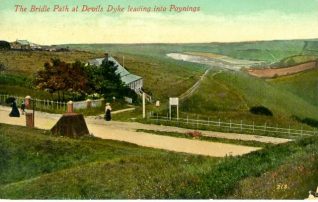
a) HISTORY: The Devil’s Dyke is a deep valley in the Downs to the west of Saddlescombe and five miles north-west of Brighton in the parish of Poynings. The adjacent hill has no particular name of its own, but is crowned by an Iron Age hill fort and, at 711 feet above sea-level, has magnificent views over the Weald. The legend of the Dyke is widely known: it is said that the Devil dug the chasm to allow the sea to inundate the churches and pious inhabitants of the Weald, but an old lady, on hearing the noise, lit a candle and Ol’ Nick, believing it to be the rising sun, left his terrible work unfinished. In reality the 300-foot-deep valley was carved by tremendous amounts of water running off the Downs during the last Ice Age when large amounts of snow thawed and the frozen chalk prevented any further absorption; erosion was aided by the freeze-thaw cycle and the valley was deepened by the ‘sludging’ of the saturated chalk.
In April 1928 Brighton Corporation, through the initiative of Herbert Carden , purchased 190 acres of downland in the area for £9,000. It was dedicated for public use by the Duke and Duchess of York on 30 May 1928 when a commemorative seat was unveiled; the inscription reads ‘God gave all men all earth to love’. The Dyke has always been a popular resort for Brightonians and there has been a refreshment building of some sort there since 1818. The first hotel building, designed by George Cheeseman, was erected in 1831 but replaced in 1871; the second hotel was burnt down in 1945 and the present structure built in 1955. Tourist attractions at the Dyke since the late nineteenth century have also included a funfair, bandstand, observatory, camera obscura and coffee rooms. Both William IV and Queen Victoria visited the Dyke while staying at Brighton.
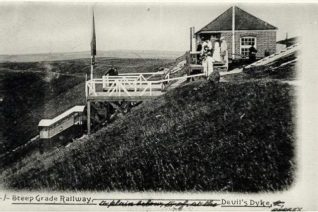
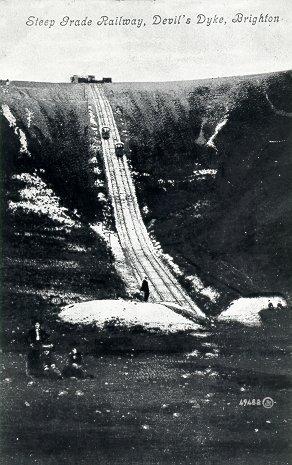
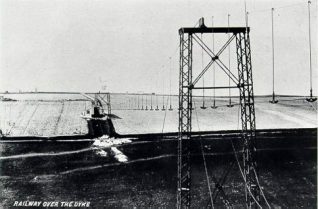
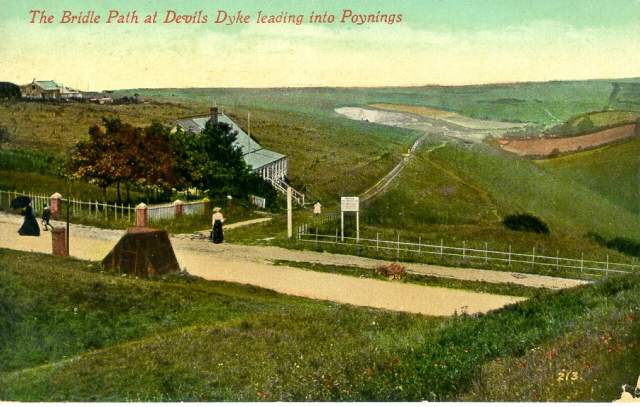
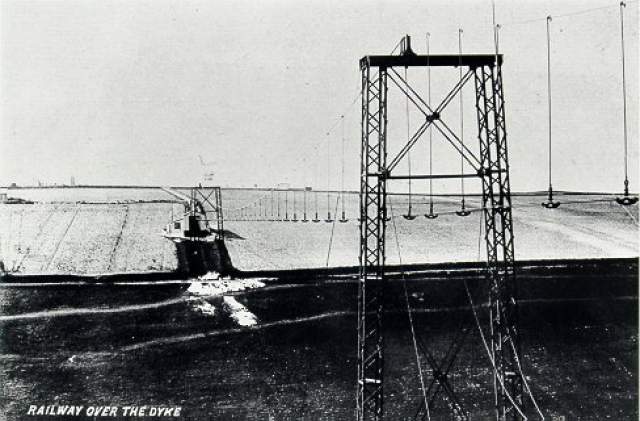
From 24 July 1897 until 1908 a steep-grade railway (maximum gradient 1:1.5) ran down the northern slope of the hill to a point west of Poynings village; the two cars carried fourteen passengers each, some 275,000 a year. The course of the railway may still be seen from the underhill lane together with the concrete base of the hill-top terminus. Across the Dyke itself ran a cable railway, suspended from two pylons 650 feet apart and providing an exhilarating trip 230 feet above the bottom of the defile. This latter attraction operated from 13 October 1894 until about 1909, but the concrete pylon bases may still be seen. A short ‘switchback railway’ or ‘roller-coaster’ also operated near the hotel. All these attractions were launched by the hotel landlord, a Mr Hubbard, but proved so successful that they took trade away from the hotel itself and he was eventually forced to close them. {79-82,109}
Any numerical cross-references in the text above refer to resources in the Sources and Bibliography section of the Encyclopaedia of Brighton by Tim Carder.



Comments about this page
I lived in Hangleton during the 1960s and it was a Sunday treat to walk up the route of the railway to the Dyke. We would look at the zoo there – does anyone else remember that? I think it was only a wallaby and a tortoise. Then an ice cream from the shop and, if we were really lucky, a trip on the open top bus (was it a 17?) to the Steine and then a Number 5 home. Can’t remember the last time I went up there. My children would be unimpressed by the simple pleasures we had.
The name ‘Devil’s Dyke’ comes from a local legend in which the devil was so enraged by the number of churches being built in the weald that in the dead of night, he began to dig a huge gully all the way to the sea to flood it. The story then tells of an old lady who heard the noise which resulted and took a lamp to investigate. The devil fled at the sight of the light mistaking it for a holy force, leaving the job half done. The dyke was in fact carved out by a vast volume of rushing water and debris at the end of the last ice age when great amounts of snow and ice melted as the temperature rose.
I dont think this is the Aerial Cableway. I think this is the steep grade railway (as it says on the card) that ran down the side of the Dyke to Poynings. The foundations of the platform are still visible and the depression in the ground that the rails made are still clear to see.
I vaguely recall cycling to the Devils Dyke with my mates soon after the war (1946-8?) and being told there was a skeleton of a whale (yes, a whale) there. It was just behind the hotel and in, or on the edge of, the woods there. I have related this to my grandaughters, who now think I have a screw loose, I have searched high and low, been on to various websites, and the Booth Museum. They were very helpful and told me of a whale that was washed up on the beach locally, but nowhere can I trace the ‘Devils Dyke’ whale. Anyone out there know anything, please make a comment. Oh, by the way, I saw it with my own eyes!
You may have seen my comments recently on a skeleton of a Whale on the Devils Dyke. My grandaughter has now come up with some information, which she discovered in a book called ‘The Cambridge Natural History’ by Frank Evers Beddard M.A.(Oxon), Vice Secretary and Prosector of the Zoological Society of London, published in 1902. As it is a rather large tome, I will just quote the relevent article Chapter X11 page 359. ‘The Greenland Whale is absolutely confined to the Arctic Ocean and reported occurrences on our coasts are due to a confusion with B.Australis. At the ‘Devils Dyke’ near Brighton, there is, or was, the skull of a most flagrant Eorqual, which is carefully labelled ‘Greenland Whale’.’ This must have been there at the turn of the 20th century. I just wonder if it was still there in the late 40s, when I thought I saw it. The whole book is published on the web if anyone is so interested.
I’m sure there was a small animal zoo park at the Dyke and will ask a family member to look out some photos. During the 1960s when we first came down to Brighton we used to get an old touring bus or something from the Old Steine upto the Dyke. Then Mum took us to see the animals which were mainly small animals like goats in some pens near the hotel.
If you Google Nigel Emery’s Gallery of Devil’s Dyke, there is a photo of the whale skeleton, and a great poster advertising both the Great Cable Railway, and the Steep Grade Railway.
We have a photograph of my mother-in-law and her sister standing by the skull!
My parents took me to visit relatives in Vale Avenue Patcham during the 1960’s, and I remember visting the small Zoo on the Devils Dyke.
Happy days!
Devils Dyke is a very different place from what it was 70 years ago. My parents used to take me there on the top of the Southdown 27 open top bus. I’m not sure where we got on the bus, did it stop at the top of Three Cornered Copse (at the top of Woodland Drive)? The bus I remember was quite slow and old, probably a petrol engined Leyland Lion. I remember standing on the top deck at the front looking down over the top of the drivers cab and destination box while it rocked and rolled its way up to The Dyke.
At that time the remains of the hotel which had been demolished were a bit of a bomb site covered with stonecrop and little wild weeds. When the bus pulled up the dusty place was nearly always empty, with a very occasional car. The one thing I remember about the ruins, because of the shattered tiling, was where the toilet had been and today it’s still in the same place, probably connected to the same pipes.
As The Dyke became more popular Southdown used open top Guy Arab buses which were a bit quicker and more frequent. Often on this seasonal service the buses were full and sometimes relief’s were added to get people back. They used to park up for about 10 minutes before returning to Brighton by the same route down Dyke Road.
The current hotel building at one time in the 60’s had an upstairs dining room, a much better position for it than now because it had wonderful views over The Sussex Weald. At that time I had a car and it was quite a romantic setting in the evenings, I remember taking a girlfriend there. It’s hard to believe that at that time you could park pretty much anywhere. Today the volume of traffic and the popularity of Devils Dyke has altered the old place from the quiet place that I remember.
Back in the 60s I remember a café at the Dyke run by an actor named Richard Wyler. I used to ride there with my motorcycle friends for a chat and coffee. Does anyone have any information on this or pictures of the Café ?
I remember the menagerie at Devil`s Dyke in the 1960s. There was most certainly a camel in residence as I have clear memory of it taking a lump out of my grandmother`s coat and she wasn`t very impressed. I thought it was rather funny, as you do when you`re about seven. We used to go up there on an open top bus I think.
Many My Brighton & Hove readers and contributors might like to know about a new history of Devil’s Dyke during the nineteenth and twentieth centuries.
It’s by Martin Easdown, author with Linda Sage of a number of authoritative works concerning the pleasure piers of our country, and — more recently — a history of the Daddy Longlegs Railway.
The Devil’s Dyke : A Delightful Spot to Spend a Happy Day (the title formed from words of 1900 publicity) beautifully looks at the surprising, fascinating and connected histories of the hotel, the Aldrington to Dyke branch railway, the Steep Grade Railway, the Aerial Cableway, the former amusement parks and exhibits, golf courses and — not forgetting — Dennett’s Corner tea room.
There is detailed coverage of the fascinating lives (not only the intentions) of the Dyke entrepreneurs : William Thacker, James Hubbard, Maud Barrasford, Fred and Cyril Pigott, Leslie and Vera Kramer.
Within the introduction is a general geological and historical overview of the vicinity of the Dyke, the Devil legend and an attractive summary of Brighton’s growth, leading to the mass tourism which brought visitors to the Dyke.
The later story leading to the permanent protection and national recognition of the site is also covered.
With numerous period illustrations, much history is published for the first time ; a valuable record.
Copies are currently available from Step Back in Time, Queen’s Road.
Thank you for that very interesting info Sam. Next time I am in town I’ll get a copy. TCS.
Add a comment about this page