Development in the 1920s


Please note that this text is an extract from a reference work written in 1990. As a result, some of the content may not reflect recent research, changes and events.
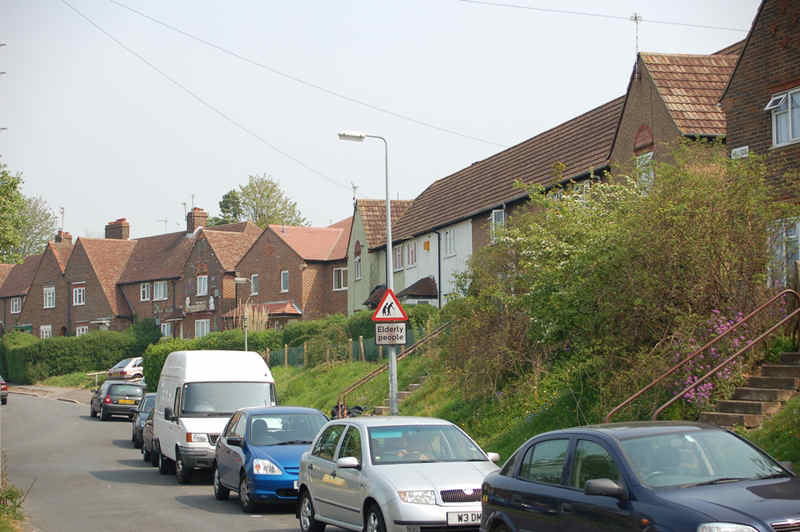
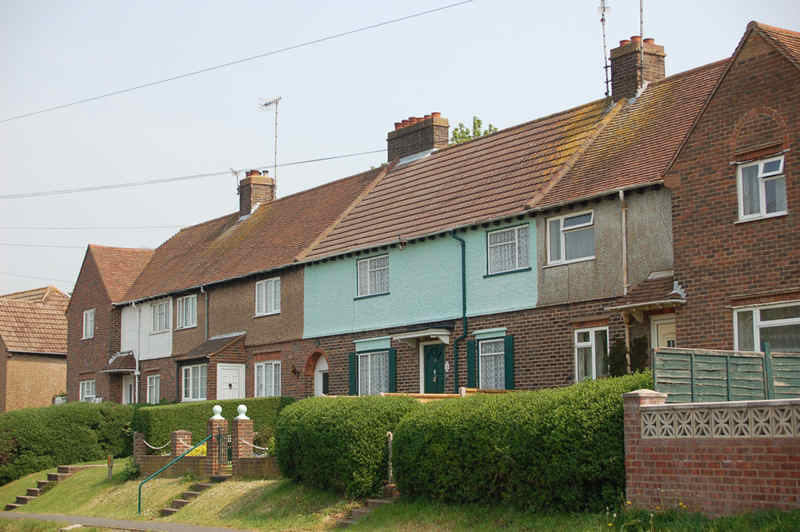
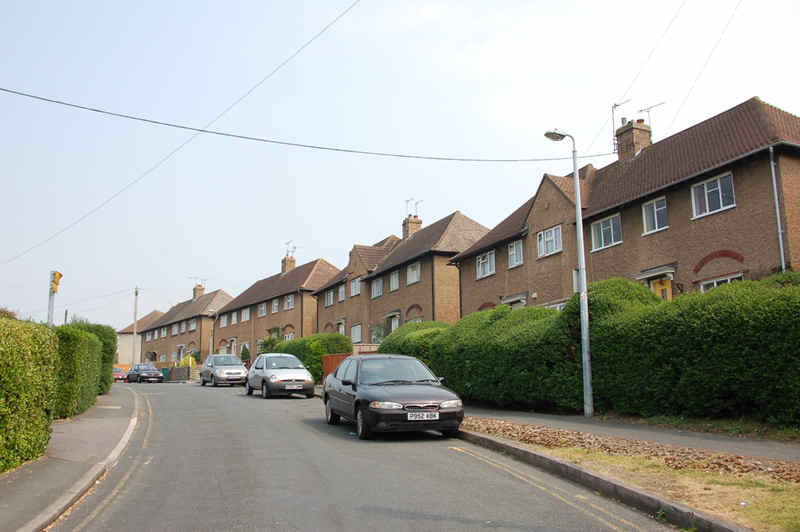
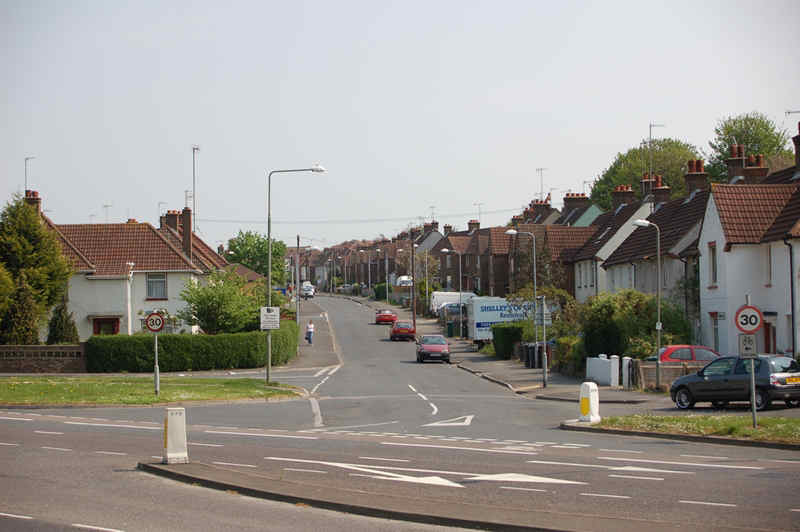
b) HISTORY AND DEVELOPMENT OF MOULSECOOMB HOUSING ESTATE: Now the borough’s largest housing estate, Moulsecoomb was also the corporation’s first large-scale estate, the initial development at South Moulsecoomb commencing in the early 1920s. This original estate, which included The Avenue , Colbourne Avenue, The Crescent, The Highway, Hillside, Southall Avenue and some houses in Natal Road, was erected on ninety-four acres of land to the east of the Lewes Road acquired in November 1920 which were annexed by the county borough from the parish of Patcham on 1 October 1923. A fierce debate raged over the spelling of the name for many years, but ‘ Moulsecoomb ‘ was generally agreed upon in the 1960s. It probably derives from the personal name ‘Mul’, and dates from at least the twelfth century. {123,289}.
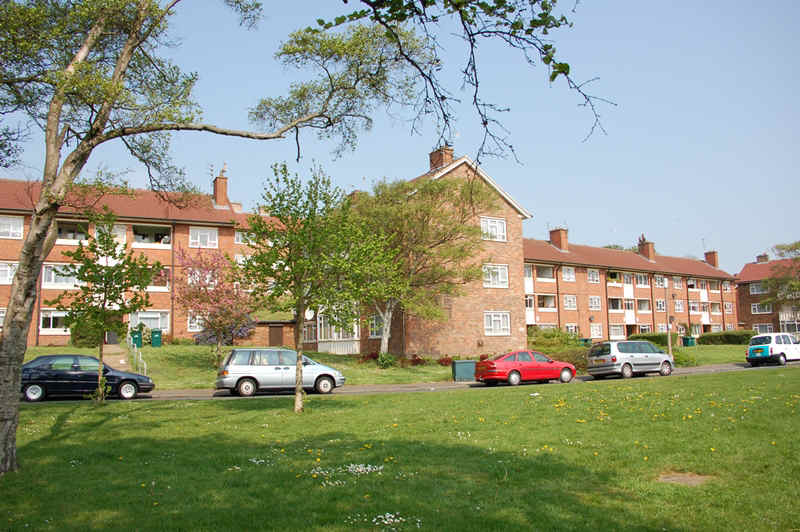
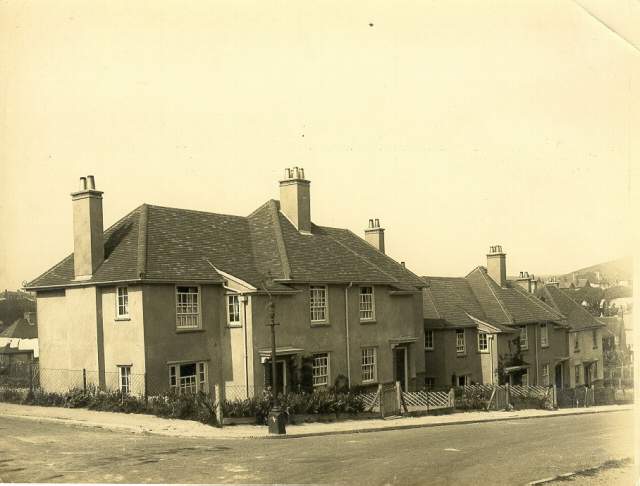
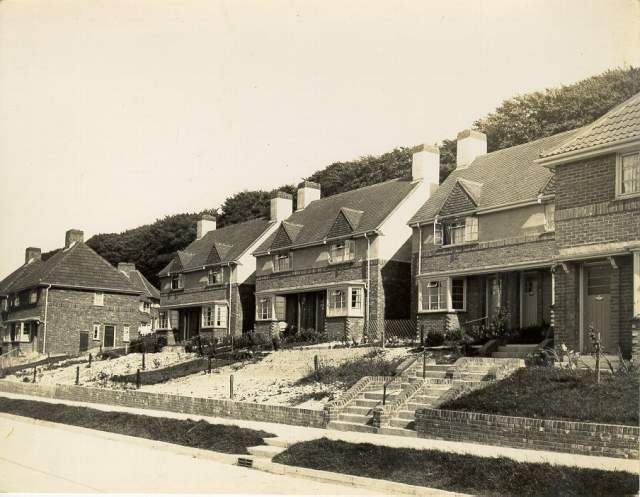
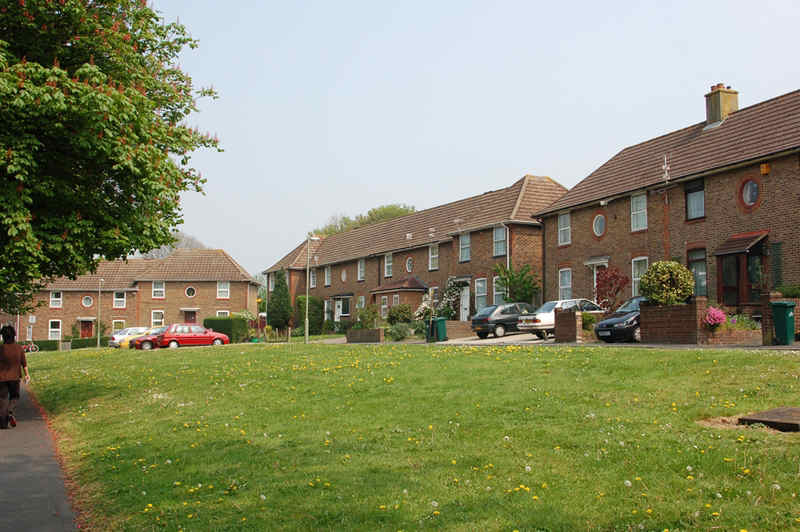
South Moulsecoomb was considered something of a model garden estate with its large open spaces and two-storey, semi-detached houses with large gardens, described as ‘homes fit for heroes’ by one alderman in the post-Great War era; there were even tennis-courts provided in The Avenue . The 478 houses were meant to provide new homes for people in the proposed slum clearance areas on Albion Hill, but the rents charged by the council were prohibitive for most of the intended residents, and tenants were brought in from other towns, especially London, following an advertising campaign. Little was therefore done to relieve the appalling conditions in central Brighton. {2,110a,123}
The North Moulsecoomb estate of 390 houses followed in 1926-30, on forty-six acres acquired in October 1925, but was developed to a higher density than South Moulsecoomb, a factor which has perhaps contributed to the social problems experienced there. Originally part of Falmer parish, the area was annexed by Brighton on 1 April 1928. Redevelopment of the estate, which has also suffered from a lack of facilities and maintenance, commenced in 1979 but has been restricted by financial restraints.
In the early 1930s the corporation extended its housing up the Bevendean valley with 85-123 and 110-120 The Avenue , Manton Road, and Upper and Lower Bevendean Avenues. As this was on land previously belonging to Lower Bevendean Farm, these new houses were known as the Bevendean estate; Moulsecoomb therefore ends at the western end of Manton Road, the limit of the original estate. There was also some private development at this time in the Bevendean Crescent/Widdicombe Way area similarly on Bevendean land, but this area is now generally regarded as part of Moulsecoomb .
The East Moulsecoomb housing estate from Hodshrove Road and Birdham Road to Moulsecoomb Way was built by the corporation on part of a 300-acre estate which was purchased in December 1935. Moulsecoomb was completed in the 1940s and ’50s with the Halland Road area and the flats of the West Moulsecoomb or Bates Estate, on the site of the Bates Nursery. In 1981 the population of the Moulsecoomb district was around 8,500. A light industrial area was developed on the slopes north-east of the railway line in 1989-91, the Home Farm Business Centre. {83,110a,277}
Any numerical cross-references in the text above refer to resources in the Sources and Bibliography section of the Encyclopaedia of Brighton by Tim Carder.


Comments about this page
My name is Vernon Page. I lived at 26 Bevendean Crescent from 1958 until 1970. Higher Bevendean was quite a sociable neighbourhood in those days. I do not know what it is like now. My brother and I would play on the green in Bevendean Crescent and we loved to roam the open hills behind our house. Every year there was a bonfire on waste land to the rear of 32 Bevendean Crescent, an area known as ‘The Dump’ by me and my mates.
There were many shops in Higher Bevendean in those days. There was Cheeseman’s greengrocer’s, Bronlow the chemist’s, Palfrey’s the newsagent’s and sweetshop (his son Graham was spoilt!), Tilley’s the grocers, a butcher’s shop, a baker’s, a hairdressers and a shoe repair shop. How many of those shops are left now? Almost none, I be bound.
At the junction of Bevendean Crescent and Widdicombe Way there was a blue (Dr. Who-style Tardis) police box. My brother Barry and I loved to play around the shops and, every bonfire night we made a Guy and shamelessly touted it about trying to get money for fireworks!
If anyone remembers me they can conact me at henrypage.personal@googlemail.com. It would be nice to find some old photos of the Upper/Higher Bevendean area to upload onto this website. Come on!
I used to live in Staplefield Drive. My mum is still there. She’s been there since 1960. Could you get any photos of that street please, Thank you.
How can that be North Moulescoomb? I used to live in Staplefield Drive, this looks like Chailey Road.
How about taking photos of Staplefield drive I lived there for 19 yrs, it was fun.
Newick Road! I’ve added a piece describing the road and occupants nearby. I was probably a couple of years old when the pic was taken right near my home.
This a modern view of Ringmer Road where it bisects Barcombe Road and joins the main road into/from Brighton proper. However, looking at it, little seems to have changed in the road’s appearance. In the 1930s there were aged elm trees and beech trees probably a hundred years old or more, all the way along the wide grass section between Barcombe Road and the main road. We used to collect the beech nuts which were quite nutritious, a jam jar full at a time. Round about 1935 one of the tree loppers, who almost annually kept the trees in shape, fell out of one of them and died.
Reference the “fierce debate” on the spelling of Moulsecoomb, when I was in the second term at Moulsecoomb Junior School, we were all told that it was the correct spelling and that the Southdown Omnibus Company had spelt it wrongly on their ‘buses. That would have been about 1937.
That old photograph certainly brought my memory into action. The lamp post is situated outside the Webb family’s house and is opposite what was known as the Cinder Path. I lived next door to the Webbs.
Our family home was in Medmerry Hill from the late 1940s (when I was 6) to the late 1970s. The shoe repair shop that Vernon mentions was at one time owned by a Mr Skerratt, whose son David I was at school with. The bakers, was I believe, owned by the Goldsmiths The sweet shop/newsagents was at one time owned by the Paynes, for whom I did a paper round, and next door to the grocers was a barbers shop. I too recall the annual ‘penny for the guy’ firework fund begging bowl and also, being in the scouts, the annual ‘Bob a Job’ week when we door knocked for chores to aid the scouting funds. Nostalgia is not what it used to be!
On the contrary John, nostalgia is what would never have been envisaged. (What is that feeling one gets in the stomach?) I also did a paper round for Paynes shop but not the one you mention. They obviously had some sort of monopoly in that direction. Many of us worked a paper round whilst under age – up at 0600 each morning – and fairly regularly the school would enquire as to who was so engaged. Nobody owned up if they were under age. The pocket money was too precious but that was a few years earlier in the 1930s.
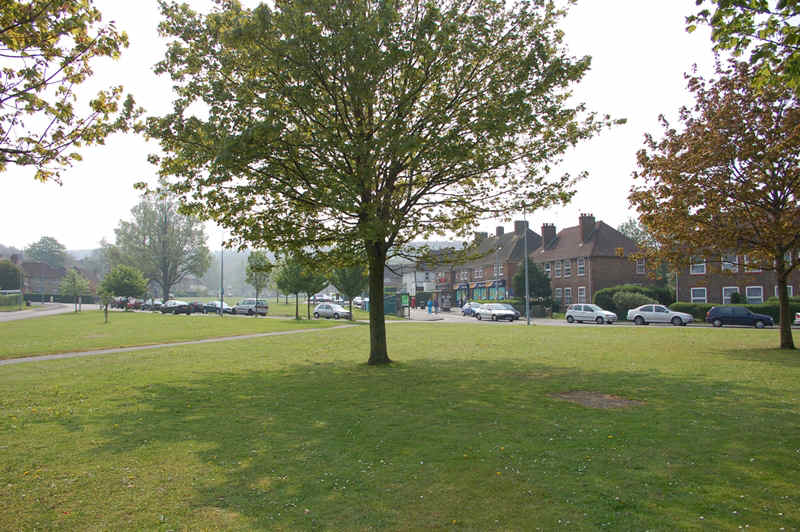
This is Hodshrove Road.
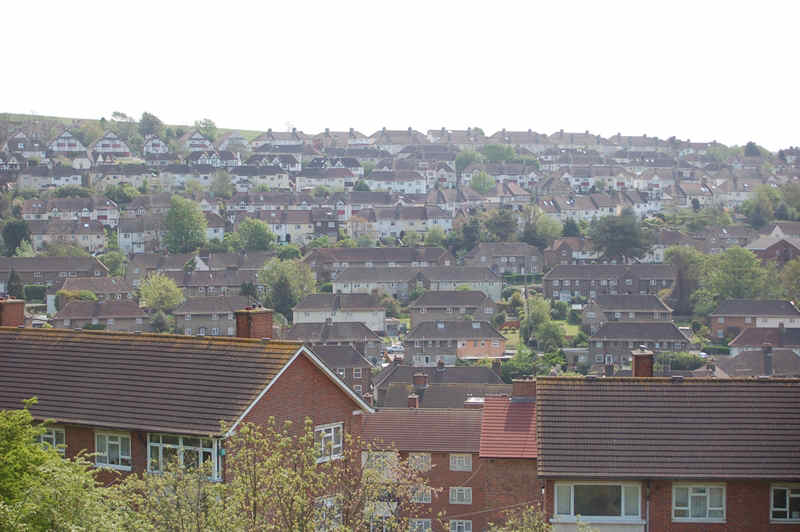
This photo is a view from Bates Estate overlooking South Moulescoomb and Bevendean although I’m not too sure if it’s higher or lower.
This is the Highway.
This is the same picture of Hodshrove in the old black and white.
Just come back for a second look at this photograph. I wouldn’t mind betting that the girl on the left was Nellie Studd who lived at 38 Newick Road; the only girl in the area rich enough to have a pram to play with! Her mum was the local midwife type who attended all the births in the area, including of course, those at my house, number 34. I’ve often been reminded of my remark when my younger sister Sylvia was born and I was about 10 years of age. A local girl, Margery Tiller who lived opposite us and often visited, came out of our house to the back door step where I was sitting and said, “You’ve now got a baby sister; what do you think of that?” I said, “There’s enough of us already!” Even at that tender age I was obviously well aware of our circumstances and how they could be worsened …
Hi Ron, I remember those trees and the grass strip. I was born and lived at 24 Barcombe Road until 1958. They were still there then.
Purely by the shape of the bend at the end, it looks like the north end of Newick Road. Taken not far from my grandparents’ house at 86 which would have been a tad further south on the same side as the girls.
Yes, you are right Paul.
Hello, I live at 33 Medmerry Hill, which I believe was the home of a boyfriend of my aunt Jackie, who lived at Bevendean Crescent next to the alleyway. Small world!
Hi Nicci. In the 1950s I had a friend, John Chatfield, who lived at 33. I believe he had 2 older brothers, but can’t recall their names. Is this the right era for your aunt?
Hi John, John Chatfield had a brother called Norman who we played with, along with Adrian Ball and Gordon Reeves, I used to live at No.7 and your sister Rosemary was my playmate – hope she is well.
Hi Val, good to hear from you. I remember the other names you mentioned but cannot put faces to them. Rose is well, and now lives in Canada, I will pass your good wishes on next time I speak to her.
Hi John, Good to hear from you too. I have remembered that the other Chatfield lad was called Ray, the eldest I believe. Norman went on to be a vicar. Glad Rose is well but Canada, my! I have fond memories of coming to call for her about teatime when your mum usually asked me in for a piece of her lovely cut-and-come cake, which was always on the sideboard, and a glass of Tizer – all part of the plan! Happy times, all seems so long ago. My sister Yvonne went to school with your brother Philip. I hope the rest of your brothers and sisters are OK. Such happy times but it’s all such a long time ago. So good to have memories.
There is some pictorial material about the origin/development of the estate in my book on East Brighton & Ovingdean.
Hi Val, I chatted to Rose recently, and she asked me to pass on her good wishes. All the rest of our siblings are well, thanks! Hope it is the same for you.
Hi John, thanks for that. Glad everyone okay as are my family – we still have our mum – 105 years old, amazing! Val
Dear Lee
Sorry but we have had to delete your post. We are no longer allowing the posting of requests to find third parties, as sharing information like this breaches their privacy. We recommend you try social media websites if you want to track old friends or neighbours.
Comments Editor
Does anyone remember the blind couple, Molly and Henry King, who lived in Birdham Road in the 1940s and had a son Brian? Their neighbours were the Whittingtons.
I was looking on the Brighton website with my daughter in Australia, reminiscing about growing up in Brighton. I then spoke about you and decided to see if you still live in Brighton. I actually live in Worthing now and staying in Australia til end of March 2018.
Hi Susan (Royston), which of the contributors were you referring to?
Hi Susan,
As no one else has responded to your message, I am thinking that perhaps it was intended for me.My apologies for sounding uncertain. I do remember well a ‘Susan’ who I knew in the early 1960s, but after more than half a century I cannot unfortunately be sure of the Surname!
So, a response, just in case. I no longer live in Brighton, like you I have migrated a few miles along the coast. If you would like to reminisce further, I would be pleased to hear from you, my email address is nathon180@gmail.com
I bet you are having better weather than us!
John
Found it! I had forgotten how to access this thread, but after scouring most of the Moulsecomb pages I eventually found my way back to it.
However no updates for over 4 years! So I am posting this in case others have lost the thread.
Add a comment about this page