The ship’s badge of HMS King Alfred.
At the outbreak of the Second World War on September 3rd 1939 Hove Marina, Hove’s new municipal swimming baths and recreation complex, was due to be partially open to the public. The site was immediately requisitioned by the Admiralty under the Naval Mobilisation Act of 1938, and the Marina opened its doors for the first time on September 11th as HMS King Alfred, a commissioned ship in the Royal Navy, under the command of Captain John Noel Pelly CBE, RN (Ret).
The new establishment trained HO (Hostilities Only) officers commissioned into the Royal Naval Volunteer Reserve on temporary appointments; they were to be released from service on the cessation of hostilities. By the end of WW2 RNVR officers accounted for over 80% of the officers on active service with the Royal Navy.
Assigning rooms
Assisted by ratings from the nearby Sussex Division RNVR depot the task of clearing builder’s rubble and converting various rooms into classrooms and offices was undertaken. The 480-car underground car park which was part of the Marina was converted into several different ‘parts of the ship’, including the officers’ mess, trainee accommodation and a ship handling simulator. The main swimming bath became the main instructional hall; this bath had been designed with a removable floor which when put in place over the pool created just over 10,000 square feet of floor space. The second largest room with 4,000 square feet of floor space was a restaurant and dance hall on the west side of the building, this became the Wardroom. Small rooms facing the Kingsway, which were intended to house individual baths, were converted into offices; classroom space was provided by the dressing rooms adjoining the pools. A smaller cleansing pool was allocated for the use of the ship’s chaplain, and by 1940 this room had been converted into St Nicholas’ Naval chapel.
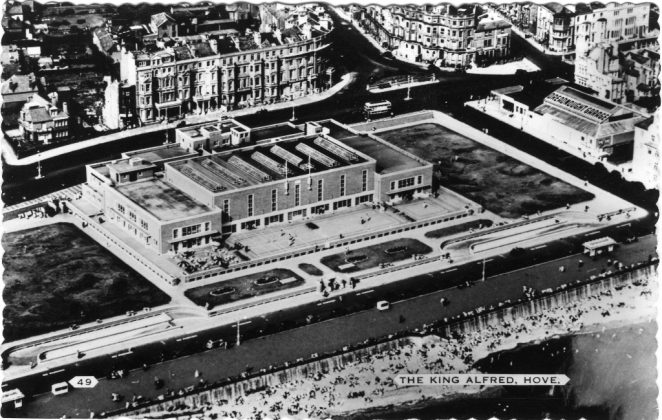
Aerial view of the Hove Marina: Note the entrances to the underground car parking garage along the south road, also the tennis courts and patio areas on the rear of the building, The grassed areas either side conceal underground bowling facilities; on the left Ten Pin Bowling alleys, on the right Lawn Green Bowling lanes.
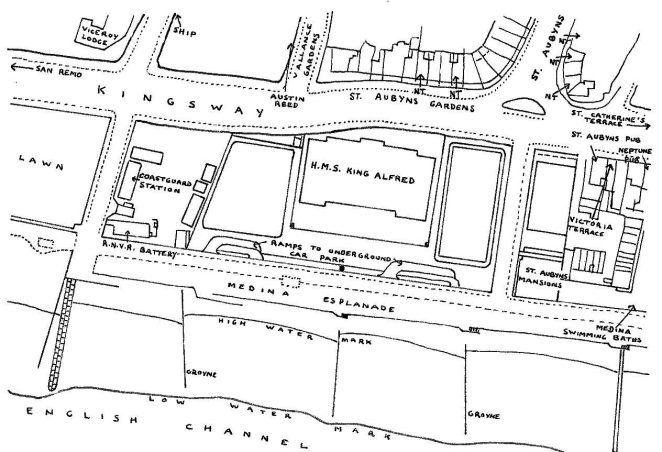
Map showing the location of the RNR Battery and HMS King Alfred in 1942. Note: NT = Naval Tailor
Many local hotels and private houses were pressed into service as accommodation for staff and trainees, these included Langfords Hotel in Third Avenue, and the Lawns Hotel on the Kingsway. Accommodation for WRNS personnel (colloquially known as Wrens) was set up in two large houses at San Remo, on the Kingsway. The ‘Wrennery’ as it was known in naval parlance initially housed 8 Wrens but by the end of the war it was home to 70, 45 of them worked at Lancing and 7 at Mowden.
First arrivals – early training
The first trainees reported to King Alfred in late September 1939, a mixture of Royal Naval Volunteer (Supplementary) Reservists and direct entry recruits. Many of the 2,000 strong RNV(S)R were mature, experienced civilian sailors who were fast tracked through King Alfred with an average stay of 10 days before being commissioned; the standard training period was 3 months. The first four classes of ‘Officers under training’ began instruction in early October, each class comprising of thirty men; two classes of midshipmen and two of sub-lieutenants. Rank was determined by age – those under 19½ became a midshipman, those over 19½ a sub-lieutenant. Upon receiving their commissions the new officers received their badges of rank, midshipmen wore a maroon lapel flash while sub-lieutenants wore a single ‘wavy’ gold stripe on their jacket cuffs; this, and wavy white tape on the RNVR ratings seamen’s jersey collar earned the RNVR he nickname ‘the wavy navy’.
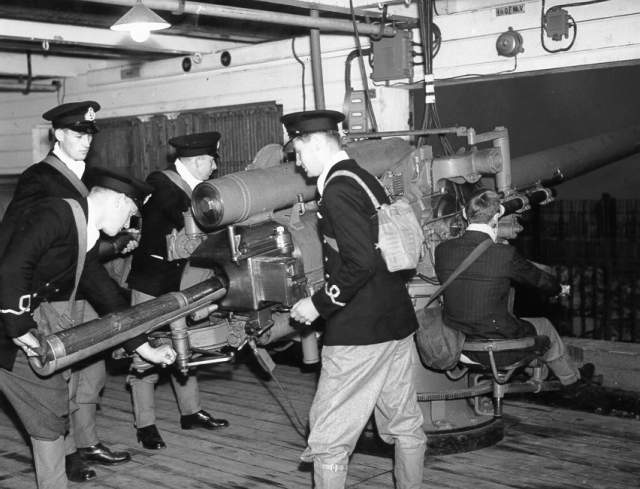
Officers under training practice gunnery drill at Hove Battery. These Sub Lieutenants RNVR were amongst the first to pass through HMS King Alfred. Note the man on the elevation operator’s seat has not yet acquired a uniform but is wearing a pin-striped jacket.
Once the RNV(S)R had all passed through HMS King Alfred the establishment trained direct entrant officers, CW Scheme and the ‘Y’ Scheme Rating Cadets. Direct entrants were ‘mature’ gentleman aged around thirty who joined as ‘officers under training’, receiving their commissions on call up. CW (Commission and Warrant) candidates were specially selected men from the lower deck, serving ratings with a minimum of 3 months’ sea experience assessed as having officer potential. The ‘Y’ scheme recruited educationally qualified young men whilst still at school who showed ‘officer potential’. Upon call up they completed basic new entrant training as naval ratings before joining King Alfred. CW and ‘Y’ scheme Cadet Ratings comprised the majority of the trainees to pass through HMS King Alfred; they were not afforded the title ‘officers under training’ until the final two weeks of the 12 week course.
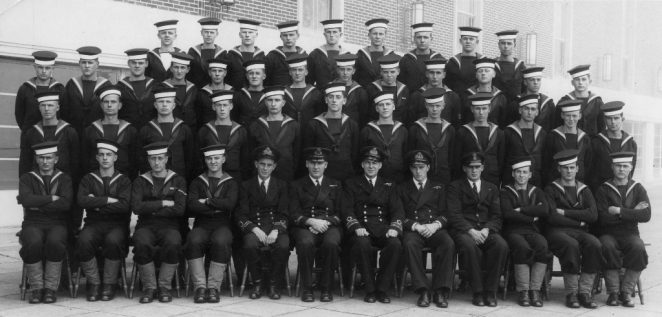
An intake of ‘CW’ candiates pose with thier class instructors at ‘King Alfred’ – Square rig was worn until the end of the course, a white band on thier caps indicated thier status a officer candiates.


Comments about this page
Interesting site. I was a pupil at King Alfred School, Ploen in Germany. It was, until captured by the British, a German Midget Submarine base, and the headquarters of Admiral Donitz who was to take over after the fall of Hitler. KAS Ploen is now back in German hands but the former pupils have their own website and regular reunions. I get the feeling it’s too much of a coincedence for there not to be a connection between the two King Alfreds!
My father, Basil Matthiae trained at King Alfred as an RNVR Officer – subsequently Commanding Officer of LCH 101. A group photograph dated 12.6.42 has been passed on to me by my mother and is signed by some of the officers who my father knew, including Ken Briggs who remained a family friend. I have been reading this website with great interest and believe it is possible that my father is shown in the group practicing gunnery drill – standing at the rear, to the left of the picture. I would be interested to receive any information related to others who may have been at HMS King Alfred at the same time.
My mother was one of the few civilians with a pass to the beach at the King Alfred during WW2 because her father, Charlie Reynolds, worked there as a civilian engineering instructor. This beach was apparently the only one in Brighton and Hove not mined or festooned with barbed wire – possibly it was left like this for some training purpose – and so was very popular in summer if you were lucky enough to have access. She also told me that Lord Haw Haw (who a lot of people listened to – it wasn’t illegal) on German radio twice claimed that the ‘HMS King Alfred’ had been sunk by the Germans!
My grandfather, Norman Haddon, signed up to join the Navy at the tender age of 15, and later trained at the HMS King Alfred. There he met my grandmother, Violet, who worked as a waitress to the naval cadets. Norman went on to serve in the Pacific Fleet on the HMS Indomitable, returning briefly in 1946 to marry Violet. Now both in their 80s, they still have fond memories of their time at the King Alfred and if it wasn’t for the HMS King Alfred, I wouldn’t be sitting typing this now!
Lara Denyer, is it possible that Violet’s maiden name was James?
RE: Basil Matthiae and LCH 101. My Grandfather George Markland served on this vessel and was involved in the landings at Rangoon. Any info on this would be greatly appreciated.
My Dad, Richard (Dick) Jordan, went through HMS King Alfred, having been a “Sick Bay Tiffy” since the outset of war. Subsequently he served on Landing Craft (Tanks) and after demob, for many years in the Sea Cadet Corp. He passed on many stories of these years.
My time at King Alfred was summer 1944 and became the run-down time following Normandy. Thirteen of us were transferred to the Indian Army in November 1944. I became a Gurkha and served mostly in the North West Frontier Province until May 1947 when India was about to become independent.
The sub lieutenant’s RNVR gold braid is incorrect. I have written elsewhere to draw attention to this including sending a scanned copy of one of my old epaulettes to help put the matter right. Where on earth Mr Drury got his incorrect idea from I cannot think. He has also made his ‘ring’ too narrow as if one was talking about a warrant officer – there was no such rank in the RNVR but only in the RN.
Re: ‘Gold braid is incorrect’. Upon reflection you are entirely right about my illustration of the sub lieutenant RNVR insignia of rank. The error is, as you point out, in the fact that I have reproduced the insignia of a warrant officer RNVR – a rank which existed only in the peacetime RNVR – if seen in isolation it could be confused with that of the thicker ring of the sub lieutenant. I will be correcting the graphic at the earliest opportunity, thank you for bringing the matter to my attention. I have checked with the web site editor regarding your previous attempts to contact us about this, and she can find no trace of any messages or attachments. The editor can be contacted at jennifer@mybrightonandhove.org.uk
I was at KA from April to June 1943 – Mowden, Lancing and Hove, the last 2 weeks as an “officer under training”. Looking back, I am surprised at the location as we were very vulnerable to air attack. KA Hove was conspicuous enough, while Lancing’s chapel would have made a first class target at which to aim. As it was, we had several air raids, but the few bombs were, luckily for us, dropped in central Brighton.
I have just recently tracked down my late father to HMS King Alfred, and I have an excellent group photo of his intake. I am more than willing to share this, and would love to know if there is a corresponding ‘graduation’ photo anywhere. I am not sure of the date, which must be 1941 on. In my picture the recruits are all wearing white vests- is this because they were direct entrants?
‘Signaller Wren’ is the title of my book of my time in WW II. It includes details and illustrations of training in the navy, culminating at Brighton and Hove. Mostly accommodated in the underground car park. I went on to the Indian Army in November 1944. The book is available from Amazon and all other on-line suppliers. The Centre for World War Two Experiences has the first page and a commendation is made by Lord Robertson of Port Ellen (Gen Sec NATO 1999- 2004)
Looking for information on a man named Ray (sorry last name unknown due to my aunt’s young age and mine at the time) who was a captain and trained at the king Alfred Naval College. He was engaged to Molly Hope Jackson of 33 Wilbury Gardens, Hove, Sussex,England
The Ray I am looking for attended the King Alfred Naval College in Hove anytime from 1940 (or late 1930s) to 1942? Hoping I can find someone still around who knew a Ray who was engaged to Molly Hope Jackson of 33 Wilbury Gardens, Hove. Any information, no matter how small is very welcome. Contact me lyncmacdonald@sasktel.net
I’m off to Brighton tomorrow (talks on Navigation History at Shoreham) and thought I would check up on HMS King Alfred. My Father passed out from Effingham Division 16 Jan 1943 having started 6 Oct 1942. I have the photo. He went to sea on HMS Cambeltown (before) on the lease lend ex US tub that then blew up the dock gate at st Nazaire. He drew lots but luckily for me did not get the short straw. Afterwards he went on to LCTs with a command of 944 ,D-Day and more frightening at Walcheren (Operation Infatuate).
My father lieutenant commander William E Saul RNVR taught navigation to the cadets after WW2 at HMS King Alfred until 1958. He was attached to mine sweeper HMS Curzon based at Shoreham Harbour.
Editor’s note: Thanks Julian. I know that Tony Drury would be very interested to hear about your father’s experiences at King Alfred. Please contact me if he would be willing to help add to the archive: jennifer@mybrightonandhove.org.uk
My father, Dick Hubberstey, trained initially on HMS Tynedale, then at Lancing College and HMS King Alfred. He went on to serve on the Destroyer ‘HMS Wallace’ (where Prince Philip was 1st Lieutenant), then on to LCT 929 as 1st Lieutenant (Commanding Officer was Charlie Jones). On LCT 734 he was Commanding Officer (Midshipman was Derek Rawlings; Sub Lieutenant Geoff White). He commanded LCT 734 until the end of the War when he sailed her to France, lowered the White Ensign (which I now have), raised the Tricolor and handed the ship over to the Mayor of Bologne.
Editor’s note: Thanks Vicky. I know that Tony Drury would be very interested to hear about your father’s experiences at King Alfred. Please contact me if you would be willing to help add to the archive : jennifer@mybrightonandhove.org.uk
Someone may be interested in this excerpt from my father’s (Christopher Holt) war memoirs. He was the first person to pass out from King Alfred in 1939. “On Saturday September 9th 1939 I received instructions to report to ‘King Alfred’ the training establishment at Hove (Sussex) on the following Wednesday. On enquiry I found that I had been appointed a Probationary Sub Lieutenant in the RNVR List II, so I rushed to Gieves to get some sort of uniform and found several other people doing the same thing. When we arrived at Hove on the Wednesday there were a number of RNV Supplementary Reserve Officers with Masters certificates etc. already there – and I was billeted in the Tatler Guest House sharing a small room with two other people. My letter of 16th was written from the Lansdowne Club as I was trying to collect my uniform from Gieves and we had been given special leave for this. It was a day which may well have had special consequences for me because instead of doing three months training as expected, at the end of that Saturday I emerged from Gieves with my uniform jacket and two pairs of trousers. My letter to my mother of September 17th tells more …. “At divisions this morning all Subs who arrived at Hove on Wednesday were told to fall out – then those without uniforms were eliminated – then those with complete uniforms were mustered – I was one, or at least I had two pairs of trousers. Four of us were chosen and here we are.” We were at the Palace Hotel, Southend (linked to what was then The Palace Hotel, Southend) and had joined the staff of the Naval Control Service which was routing and sailing all the shipping from the Port of London. My letter continued ….. “We are an amusing selection. When we were asked our jobs they were stockbroker (me), nothing (sailing a yacht), steel ring maker and theatrical manager.” Of the four of us, the chap who had the best war was Martin Solomons, the theatrical manager, who got a D.S.C in Motor Gun Boats in the Mediterranean. Another little quirk was that, possibly because I was tallest, I was put in charge of the party and I was officially the first officer to leave “King Alfred” as my flimsy (service record) is No. A/1.”
RE: the comment from TONY BULL 29/07/2008 regarding his grandfather George Markland being on LCH 101 which my father Basil Matthiae commanded, I can confirm that I have a photo taken by my father of AB Markland and would be pleased to pass on copies of this and other photos and information to him – I can be contacted by email at david@matthiae.demon.co.uk
Message deleted. [Hello Edward, I am very sorry but we are no longer permitted to request details about a person’s whereabouts for data protection reasons. I do hope that you manage to make contact]
After searching for 50 years for my father who served aboard HMS Fidelity as James Stephens, I never knew his real name being French, 3 weeks ago I was contacted by a brother and 2 sisters in France with his real name which was Jacques Robere Vieuxbled. He then went on to HMS King Alfred in 1942 and then into submarines, then to midget subs till the end of the war. I knew nothing of this till 3 weeks ago so thought I would make contact and see if anyone remembers anything at all? Kind regards.
My father spoke little of WW2 but I believe that initially, prior to sea service, he was a seamanship instructor at HMS King Alfred probably in about 1940. His name was Sub Lieutenant Gordon Henry Richards, RNVR. I know little else of his war except that he was either 1st Lieutenant or in command on LCTs on the Sicily landings and at Anzio where he was wounded. Any information would be wonderful.
The mention above of the ‘underground car park’ beneath the KA is interesting as in about 1951 or ’52 my father bought a Rolls Royce Phantom II which had allegedly been standing in that car park since before the War. So did HMS King Alfred take over the whole of the car park? I remember going there with him to collect it. We had to drain the stale petrol out of it and put fresh petrol in it before it would start. I still remember the smell of that stale petrol today! An awful lot of cars were stored away for the ‘duration’ in places like that. Of course the sad thing is that some owners never returned to collect them. I often wonder who it had belonged to and why it was there, had it belonged to one of those officers? . I can’t remember the name of the chap we bought the car from but I think he had a newsagents shop down at Whitehawk. It might have been Gutteridge if that means anything to anyone? I expect it was probably only about £150 or less in those days and after being re-sprayed and done up was probably only sold for £400 or so, be a lot more than that now. We don’t even have a photo of that one and I can’t remember ever going out in it so we couldn’t have kept it for very long.
Patrick C. Cother reported for training at the HM King Alfred in 1939. He completed training and was sent to the North Atlantic area to be on convoy duty, the Corvettes were converted fishing boats, bouncing around in terrible weather. Dad was a Temp. Sub. L. and was awarded a medal for being part of a team that sunk a sub.
I was in a Lancing college class 13th Aug to12th Nov 1943 receiving my commission on the 20th Oct 1943.
Is there anyone out there from the same period?
My mother died recently and I have found a picture of my father in a formal group photo whilst at King Alfred. He trained there for 3 months, March – June 1943. He was a Sub-Lieutenant in Greynville Division. I’m very happy to share the photo with anyone interested.
Replying to Mevryn Tommey – my father was at Lancing College, almost certainly about 1943. His name was Dick Hubberstey. I don’t have a photo of him at the College but I have others. I’m happy you get in touch.
My father, Arthur Frank Walsham (Bob) went through RNVR officer training at HMS King Alfred from 19 April 1942 till 16 July 1942. He was promoted to Temp. Sub Lieutenant on 17 July 1942. I have a group photo of those completing the course with the main building behind. He joined HMS Sennen that was involved in the Atlantic convoys where he was third officer in command, and the Gunnery Officer. I would be very interested to hear from anyone whose relative was either at King Alfred on the same course or on HMS Sennen.
I was interested to read about the “Wrennery” established in two houses in what was the Victorian terrace called San Remo (now 173 to 187 Kingsway). I suspect I may live in one of them, since I can find no other records of residents during the war. If anyone has any information about the two houses used, I’d be very interested to know more! I can be contacted at johndkipps@gmail.com
My Uncle, John Stanley Victor Cleaton applied to the Royal Naval Volunteer Reserve Y scene , in Coventry. On Friday 17th Sept 1943, he went to the recruiting office in Coventry for a medical and to complete some tests etc. This information came from a diary of his.
I have a group photo of him in uniform but no date or place, I assume he was at HMS King Alfred ? Does anyone know if there are lists of recruits anywhere?
I also have his Navy service number but can’t find mention of him anywhere
I have a photo of him in uniform, labelled shore patrol Headquarters Hong Kong 1st July 1946.
I am interested to find out more and can be contacted at
Tinasimpson2009@hotmail.co.uk
Hello –
I was discovering my family tree and it led me to my papas brother William Johnstone Mcculloch, he was born 1924 died 1944 at the age of 20 years. He was buried in bermuda due to dying in a hospital there. It talks about HMS Alfred ? Cant seem to find any more information on this. What was HMS alfreda ? As can’t seem to find any ship with that name. Would love to find out more if anyone has any more information /pictures.
Thank you
Dawn Paton
Dawn_mcneill@hotmail.co.uk
Add a comment about this page